Portrait of urban residents’ demand for old-age services: 90% of the "post-80 s" respondents have an old-age plan, and the average cost of old-age care is expected to be 1.006 million.

Economic Observer Network reporter Lei Huang Over 90% of urban residents have considered their parents’ pension problems, and 30-39 years old is the peak age to consider their own pension problems; Respondents estimated that their pension expenses averaged 1.006 million yuan …
On December 23rd, China Gerontology and Geriatrics Society’s Aging Finance Branch, Tsinghua University Silver Economy and Health Wealth Development Index Research Group, and Everybody Insurance Group jointly released the Report on the Demand for Urban Old-age Services in China (2021) (hereinafter referred to as the "Report"). The survey lasted for 7 months, covering 800,000 urban residents in 19 provinces across the country, and made a big data portrait of the demand for old-age services for urban residents aged 30-85 in China.
According to the report, the average age of parents in the 30-49 age group is 66 years old, and they already have health concerns, and their sub-health situation is serious. At the age of 40, they began to face the turning point of health status and generally paid attention to health management. The family structure of "post-80s" is a typical "421" model, that is, two couples have to support four elderly people while raising one child, and the pressure is enormous. They often passively consider their parents and their own future pension issues after getting married and having children, which makes "post-80s" pay more attention to the overall family pension decision. At the same time, although only 39% of the 30-39-year-old group has taken care of the elderly, 90% of them have already begun to plan for the elderly, that is, 90% of the "post-80 s" have their own pension plans.
Tang Ning, assistant to the general manager of Everybody Insurance Group and general manager of Everybody Jiantou, said that the report showed that the number of respondents who preferred institutional pension was as high as one quarter to one fifth, and home-based pension still accounted for the largest proportion, but it has begun to decline. Tang Ning believes that more people accept institutional pension and the current trend of declining birthrate is related. From the age point of view, the "post-60 s" are at the peak of wealth accumulation, so they will be willing to spend more money to pay for old-age consumption, and their willingness to pay will become stronger with the increase of academic qualifications, age and ability to pay.
Tang Ning said that the data shows that nearly 30 million people will retire every year from 2022. This group of retirees is the "golden generation" in the era of reform and opening-up, and they will become the main consumer of providing for the aged in China in the next 10 years. He believes that this generation is very different from the previous generation in wealth accumulation, social status and ideas. The sharp increase in the proportion of middle-and high-income elderly people also means that the future pension consumption market has great potential.
40Years old become a turning point in health
According to the report, 40% of the residents have problems with their health: 58.6% of the respondents think their health is "good" and 27.1% are in "sub-health". There are more people suffering from chronic diseases such as hypertension and diabetes, accounting for 11.9% and 7.2% respectively.
From the analysis of age, it is found that the physical function of human body shows a downward trend with the increase of age. At the age of 40, people’s health has turned to an inflection point, and their bodies are no longer in a "sub-health" state. "Real" patients have begun to appear, and the proportion of chronic diseases or major diseases has gradually increased.
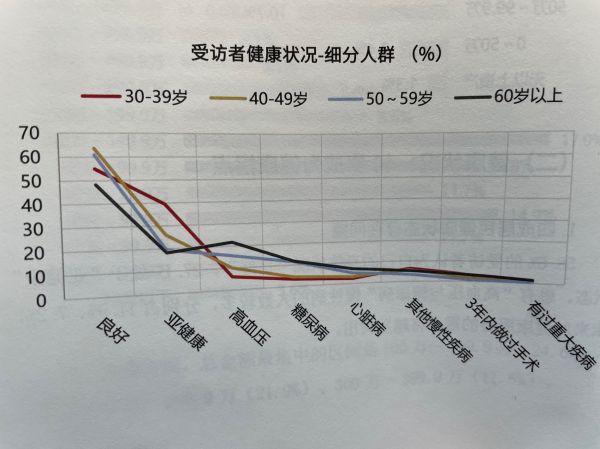
At the same time, the report pointed out that the proportion of sub-health and illness in first-tier cities is high. Respondents in first-tier cities have a higher sub-health status than those in other cities, and the prevalence of hypertension and diabetes is higher. From the analysis of city level, with the sinking of cities, the proportion of residents in new first-tier cities and second-tier cities in "good" physical condition is higher than that in first-tier cities. From the perspective of income, the health status of high-income people is not as good as that of middle-income people, and the proportion of chronic diseases (hypertension, diabetes, heart disease, etc.) is higher than that of ordinary people.
The average age of considering their own pension is 39.7 years old.
As for the cognition of providing for the aged, the survey shows that providing for the aged has become a common concern of the respondents, with 77.0% of the respondents having considered their own problems and 91.7% of the population having considered their parents’ problems. It has become a common phenomenon for people over 30 to "consider both their own pension and their parents’ pension".
Among them, 30-39 years old is the peak age group (40.0%) to consider their own pension problems, followed by 40-49 years old (33.9%). The average age when considering the problem of providing for the aged is 39.7. Among them, the "post-80s" considered their own old-age care earlier than the "post-60s", which shows that with the changes of ideas, society and economy, young people are no longer bound by the traditional family concept of old-age care, have a full understanding of the aging trend, put forward higher requirements for the quality of life, and pay more attention to the planning of old-age care life.
According to the report, the proportion of women (79%) considering the problem of providing for the aged is greater than that of men (76%), and the proportion of people in first-tier cities (80.5%) considering the problem of providing for the aged is greater than that in new-tier cities (76.7%) and second-tier cities (73.1%). From the intergenerational point of view, the post-80s generation, considering themselves (85.8%) and their parents (94.7%), has a higher proportion of providing for the aged than the post-70s generation, showing more anxiety about providing for the aged.
45.6% of the respondents said that "when parents are sick and hospitalized" is the first consideration scenario for old-age care; According to the age of the interviewees, people aged 50 and above are more inclined to consider providing for the aged when they are nearing retirement, while those aged 30-49 tend to consider when their parents are sick/hospitalized.
In terms of pension planning, from the age point of view, 48% of the 50-59-year-old group has started to plan and put it into action, and 44% of the 40-49-year-old group has plans and actions for the elderly. Although only 39% of the 30-39-year-old group has plans for the elderly, 90% of them have already started to plan for the elderly.
Regarding the main ways of urban residents’ old-age planning, whether for themselves or their parents, the old-age planning can be roughly divided into four gradients: the first gradient (about 50%) is physical exercise and regular physical examination, the second gradient (about 40%) is making money and financing (buying wealth management products and insurance products), the third gradient (about 30%) is inquiring about old-age information and inspecting old-age institutions, and the fourth gradient (below 15%)
It is found that the post-80s people are more active in planning for their own old-age care, they will exercise, make money and buy insurance, and 40% of the post-70s and post-60s people begin to visit the old-age care institutions, which shows that they are gradually facing the problem of providing for the elderly and begin to visit nursing homes for their parents or themselves.
Expectation of pension expenses: 1.006 million yuan on average.
According to the survey, respondents expect their pension expenses to average 1.006 million yuan. Different ages have different perceptions of pension expenses, and the younger the crowd, the greater the estimated amount of pension expenses. People aged 30-39 are expected to spend 1.221 million yuan on old-age care. With the increase of age, it is expected that the cost of providing for the aged will gradually decrease.
According to the report, on the one hand, young people think that it will be many years before they provide for the elderly, and the inflation factor is taken into account for the cost of providing for the elderly; On the other hand, it also takes into account the demand for the quality of old-age services.
The average estimated cost of providing for the aged in first-tier cities is 1.159 million yuan, which is higher than that in other cities.
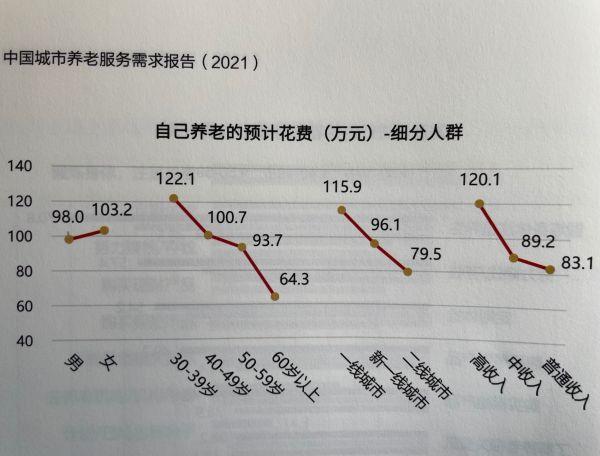
Faced with the question of "how much are you willing to pay for your future pension", the feedback data of the respondents showed that the average monthly payment was 8255 yuan. According to the breakdown of people in different city levels, it is found that respondents in first-tier cities are willing to pay the highest cost for their own pension, with an average of 9104 yuan per month, which is nearly 2000 yuan higher than respondents in second-tier cities. High-income people are willing to pay an average of 10,480 yuan per month for their own pension, which is twice the budget of ordinary income people.
Respondents expect parents’ pension expenses to be 8341 yuan/month. Respondents have the same attitude towards themselves and their parents in terms of pension budget expenses, basically starting from the actual situation and referring to the pension market and their own economic ability. There is little difference between the monthly pension expenses they are willing to pay for their parents and themselves, and the difference value fluctuates around 1%.