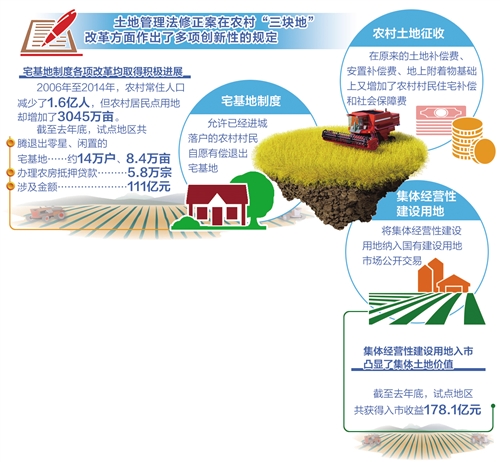
Rural land system is a national basic system, and the reform of rural land system is related to the vital interests of farmers. The revision of the land management law has made the latest provisions on rural "three plots of land" such as rural land expropriation, collective management construction land entering the market, and homestead system reform. While protecting farmers’ land rights and interests, it has realized a major institutional innovation in rural land management — —
At the 12th meeting of the 13th the National People’s Congress Standing Committee (NPCSC), which closed on August 26th, the decision on amending the Land Management Law and the Urban Real Estate Management Law was voted by the meeting. Because the law involves the reform of "three plots of land" in rural areas — — Rural land expropriation, collective construction land entering the market and homestead system reform have attracted much attention.
The subjects involved in the reform of rural land system and the interests involved are very complicated, which will affect the whole body and must be promoted cautiously and steadily. In this regard, the National People’s Congress Standing Committee (NPCSC) authorized the State Council three times to actively and steadily promote the pilot reform of rural land system. Since 2015, the relevant reform pilot work has been carried out in 33 regions across the country, forming a number of institutional innovations that can be replicated, promoted and facilitated.
On the basis of summing up the pilot experience and absorbing the reform results, the newly adopted amendment to the land management law insists on unshakable public ownership of land, the interests of farmers are not damaged, the strictest farmland protection system and the strictest economical and intensive land use system, which has upgraded the successful experience of the CPC Central Committee in the rural land system reform and made a number of innovative provisions in the rural "three plots" reform.
Rural land expropriation:
Give more protection to land-expropriated farmers.
In the reform of "three plots of land" in rural areas, the reform of land acquisition system is called the most difficult bone to chew. The current land expropriation system in China has some defects, such as too wide scope of land expropriation right, low compensation standard and single resettlement way. In view of these problems, the Third Plenary Session of the 18th CPC Central Committee proposed to narrow the scope of land acquisition, standardize the procedures of land acquisition, and improve the reasonable, standardized and diversified security mechanism for land-expropriated farmers. In the pilot process, the reform of land acquisition system in various places made great efforts to make breakthroughs in narrowing the scope of land acquisition and actively practiced in standardizing land acquisition procedures.
"The amendment clearly defines the public interest of land acquisition for the first time. It turns out that both the Constitution and the Land Administration Law stipulate that the state can expropriate land for the needs of public interest, but there is no clear legal provision on what is public interest. At the same time, the Land Management Law also stipulates that any unit or individual must use state-owned land when using land, which leads to expropriation becoming the only way to obtain land. " Wei Lihua, director of the Regulation Department of the Ministry of Natural Resources, said that on the basis of summing up the pilot experience, the revision adopted the enumeration method, which clearly defined what is public interest and which can use the state expropriation right.
In addition, the amendment to the Land Management Law also made it clear for the first time that the basic principle of land expropriation compensation is to ensure that the original living standards of landless farmers are not reduced and their long-term livelihood is guaranteed. "The regulations have changed the original purpose of land expropriation to determine land compensation in the past, the land compensation fee and resettlement subsidy are determined by the annual output value multiple method, and the original annual output value multiple method of land is replaced by the comprehensive land price of the district. On the basis of the original land compensation fee, resettlement compensation fee and ground attachments, rural villagers’ housing compensation and social security fee have been added, thus legally constructing a more perfect security system for landless farmers. " Wei Lihua said.
Yang Heqing, deputy director of the Economic Law Office of the Legal Affairs Committee of the National People’s Congress Standing Committee (NPCSC), pointed out that this revision has also improved the procedures for land expropriation, requiring the government to conduct land survey and information disclosure before land expropriation, and to consult with the landless farmers, organize hearings when necessary, and sign an agreement with them before applying for land expropriation, thus greatly protecting the interests of farmers.
Collective operating construction land entering the market:
Pave the way for the development of urban-rural integration
In Wei Lihua’s view, the entry of collectively operated construction land into the market is the biggest highlight of the revision of the land management law. Previously, it was stipulated that collectively-operated construction land could not enter the market. If it is to enter the market, it must be changed to state-owned land.
"The amendment to the Land Management Law has broken the legal barriers for rural collective construction land to enter the market. Article 43 of the original land management law was deleted, and any unit or individual who needs to use land must use state-owned land. It is added that rural collective construction land can be directly used by units or individuals other than rural collective economic organizations by means of transfer or lease, provided that it conforms to the plan and is registered according to law, and with the consent of more than two-thirds of the members of the collective economic organizations. At the same time, users can transfer it again by means of transfer, exchange and mortgage after obtaining rural collective construction land. " Wei Lihua said that this is a major institutional innovation, which cancels the dual system that collective construction land cannot directly enter the market for many years, and removes institutional obstacles for the integration of urban and rural areas.
Experts said that giving collective construction land the same power as state-owned construction land, and bringing collectively-operated construction land into the state-owned construction land market for public trading, has given full play to the decisive role of the market in the allocation of land resources, and achieved equal access to the market and fair competition between urban and rural land.
In addition, the industry believes that this move is conducive to revitalizing rural collective assets and improving land security. During the pilot project, Deqing, Zhejiang, Changyuan, Zezhou, Shanxi, Haicheng, Liaoning and other places entered the market to build township (town) industrial parks through collective construction land adjustment, which provided an effective platform for promoting rural industrial agglomeration and transformation and development. By the end of last year, the pilot areas had gained a total income of 17.81 billion yuan. Among them, Zhejiang Deqing has entered the market with 183 cases and 1,347 mu of collective construction land, and rural collective economic organizations and farmers have gained a net income of 270 million yuan, benefiting more than 180,000 farmers, covering 65%.
Reform of homestead system:
Allow villagers to voluntarily withdraw with compensation.
"Old houses can’t be demolished, and the new population has no land for approval". Before the pilot reform, the basic characteristics of the rural homestead system were free acquisition, one house for one household, legal area and restricted transfer. However, with the young and middle-aged people entering the city, many rural homesteads are idle, and there are problems such as "one household has more houses". The data shows that by the end of 2015, the land for rural residential areas in China was 285 million mu. Among them, from 2006 to 2014, the permanent population in rural areas decreased by 160 million, while the land for rural residential areas increased by 30.45 million mu.
Driven by the reform of the homestead system and the unified registration of rural real estate, all the reforms of the homestead system have made positive progress, from the registration and certification of confirmation of rights to the self-management of villagers to the voluntary paid exit of the homestead. By the end of last year, about 140,000 households and 84,000 mu of scattered and idle homesteads had been withdrawn from the pilot areas, and 58,000 rural housing mortgage loans were handled, involving an amount of 11.1 billion yuan. Experts said that the reform of the homestead system has guaranteed farmers’ land rights and interests and effectively met farmers’ diversified housing needs by solving problems left over from history. The system design of rural housing mortgage, paid withdrawal and circulation has increased farmers’ property income.
Wei Lihua said that at present, some rural villagers have settled in the city. Regarding the question of whether their original homestead in rural areas is allowed to withdraw, this amendment proposes to allow rural villagers who have settled in the city to voluntarily withdraw from the homestead with compensation. "If farmers are unwilling to withdraw from the homestead, the local government cannot force them to withdraw from the homestead, and it must be on a voluntary and paid basis."
Yang Heqing introduced that China implements the basic management system of one household and one house for homesteads, which will lead to the shortage of homestead land in some places with few people and lots of land. In this regard, the revision of the law requires local governments to find other ways to ensure the realization of rural residents’ right to live. In addition, the authority to examine and approve rural residential sites has been delegated, and it is clearly required to arrange rural residential sites reasonably through planning to facilitate the improvement of rural living conditions.
Reporter Zhang Xue