The General Office of the State Council, the General Office of the Central Committee of the CPC issued the Opinions on Further Reducing the Students’ Homework Burden and Off-campus Training Burden in

  Recently, the general offices of the General Office of the Central Committee of the CPC and the State Council issued the Opinions on Further Reducing the Students’ Homework Burden and Off-campus Training Burden in Compulsory Education, and issued a notice, requiring all localities and departments to conscientiously implement it in light of the actual situation.

  The full text of "Opinions on Further Reducing Students’ Homework Burden and Off-campus Training Burden in Compulsory Education Stage" is as follows.

  In order to thoroughly implement the spirit of the 19th National Congress of the Communist Party of China and the Fifth Plenary Session of the 19th Central Committee, effectively improve the level of school education, continuously standardize off-campus training (including online training and offline training), and effectively reduce the excessive workload of students in compulsory education and the burden of off-campus training (hereinafter referred to as "double reduction"), we hereby put forward the following opinions.

  I. General requirements

  1. Guiding ideology. Adhere to the guidance of the Supreme Leader’s Socialism with Chinese characteristics Thought in the New Era, fully implement the Party’s education policy, implement the fundamental task of cultivating people by virtue, focus on building a high-quality education system, strengthen the role of school education as the main front, deepen the governance of off-campus training institutions, resolutely prevent acts that infringe on the interests of the masses, build a good education ecology, effectively alleviate parents’ anxiety, and promote students’ all-round development and healthy growth.

  2. Working principles. Adhere to the student-oriented, respond to concerns, follow the laws of education, focus on the healthy growth of students’ body and mind, protect students’ right to rest, improve the overall quality of school education and teaching, actively respond to social concerns and expectations, and reduce the burden on parents; Adhere to the rule of law, treat both the symptoms and the root causes, strictly implement the compulsory education law, the law on the protection of minors and other legal provisions, and strengthen source governance, systematic governance and comprehensive governance; Adhere to government-led, multi-party linkage, strengthen government co-ordination, implement departmental responsibilities, give full play to the main role of schools, improve security policies, and clarify the collaborative responsibilities of home, school and community; Adhere to overall planning and steady implementation, fully implement the relevant provisions of the state on reducing students’ excessive academic burden, pilot key and difficult issues first, actively promote typical experiences, and ensure the smooth and orderly work of "double reduction".

  3. Work objectives. The teaching quality and service level of the school have been further improved, the assignment is more scientific and reasonable, the after-school service of the school basically meets the needs of students, students return to campus better, and the training behavior of off-campus training institutions is fully standardized. Students’ excessive homework burden and off-campus training burden, family education expenditure and parents’ corresponding energy burden were effectively reduced within one year, and the results were remarkable within three years, and the people’s educational satisfaction was significantly improved.

  Second, reduce the total amount and duration of homework in an all-round way, and reduce students’ heavy workload.

  4. Improve the operation management mechanism. Schools should improve the management methods of homework, strengthen the overall planning of homework in discipline groups and grade groups, rationally regulate the homework structure, and ensure that the difficulty does not exceed the national curriculum standards. Establish a publicity system for homework in schools and strengthen quality supervision. It is strictly forbidden to assign homework to parents or in disguised form, and it is strictly forbidden to ask parents to check and correct homework.

  5. Classify and clarify the total amount of work. The school should ensure that the first and second grades of primary school do not assign homework, and can arrange consolidation exercises appropriately in the school; The average completion time of written homework in grades three to six of primary school is no more than 60 minutes, and the average completion time of written homework in junior high school is no more than 90 minutes.

  6. Improve the quality of homework design. Give play to the functions of homework diagnosis, consolidation, learning situation analysis, etc., and incorporate homework design into the teaching and research system. The system designs basic homework that conforms to age characteristics and learning rules and reflects the orientation of quality education. Encourage the arrangement of layered, flexible and personalized operations, resolutely overcome mechanical and ineffective operations, and eliminate repetitive and punitive operations.

  7. Strengthen the guidance of homework completion. Teachers should guide primary school students to basically complete their written homework in school, and junior high school students should complete most of their written homework in school. Teachers should carefully correct homework, give timely feedback, strengthen face-to-face explanation, carefully analyze learning situation, and do a good job in answering questions and counseling. Students are not allowed to approve and correct their own homework.

  8. Make scientific use of spare time. Schools and parents should guide students to finish the remaining written homework after coming home from school, carry out necessary schoolwork, engage in housework as much as they can, carry out appropriate physical exercise, and carry out reading and literary activities. Individual students who fail to finish their written homework after hard work should also go to bed on time. Guide students to use electronic products reasonably, control the duration of use, protect their eyesight health and prevent internet addiction. Parents should actively communicate with their children, pay attention to their psychological emotions and help them develop good study and living habits. Boarding schools should make overall arrangements for after-school study and life.

  Third, improve the level of after-school services to meet the diverse needs of students.

  9. Ensure after-school service time. Schools should make full use of the advantages of resources, effectively implement various after-school education activities, and meet the diverse learning needs of students on campus. Guide students to voluntarily participate in after-school services. In principle, the end time of after-school service is not earlier than the local normal off-duty time; For students with special needs, the school should provide delayed custody services; Junior high schools can set up self-study classes on weekdays. Schools can co-ordinate arrangements for teachers to implement the "flexible commuting system".

  10. Improve the quality of after-school service. Schools should formulate after-school service implementation plans to enhance the attractiveness of after-school services. Make full use of after-school service time, guide students to finish their homework carefully, give remedial guidance and answer questions to students with learning difficulties, expand learning space for students with spare capacity, and carry out colorful popular science, style, art, labor, reading, interest groups and community activities. Do not use after-school service time to teach new lessons.

  11. Expand after-school service channels. After-school services are generally undertaken by teachers in our school, and can also be provided by retired teachers, qualified social professionals or volunteers. The education department can organize outstanding teachers in the region to carry out after-school services in schools with weak teachers. Seriously investigate and punish teachers’ paid remedial classes outside the school according to the law and regulations, until they are disqualified from teaching. Make full use of social resources and give full play to the role of extracurricular activities such as children’s palace and youth activity center in after-school service.

  12. Strengthen and improve the free online learning service. Education departments should collect and develop rich and high-quality online education and teaching resources, make use of national and local education and teaching resource platforms and high-quality school network platforms, and provide students with high-quality thematic education resources and learning resources covering all grades and disciplines free of charge, so as to promote the balanced development of educational resources and promote educational equity. All localities should actively create conditions and organize outstanding teachers to carry out free online interactive exchange and answer questions. Schools around the country should increase publicity and use, and guide students to make good use of free online quality education resources.

  Four, adhere to strict governance, comprehensively regulate the behavior of off-campus training.

  13. Adhere to strict examination and approval institutions. All localities will no longer approve new off-campus training institutions for students in compulsory education, and the existing discipline training institutions will be uniformly registered as non-profit institutions. The online discipline training institutions that were originally filed were changed to the examination and approval system. All provinces (autonomous regions and municipalities directly under the Central Government) should conduct a comprehensive investigation of the online discipline training institutions that have been filed, and re-apply for examination and approval procedures according to the standards. If it fails to pass the examination and approval, the original registration and Internet information service business license (ICP) shall be cancelled. For non-disciplinary training institutions, all localities should distinguish between sports, culture, art, science and technology, clarify the corresponding competent departments, formulate standards by classification, and strictly examine and approve. Seriously investigate and deal with off-campus training institutions that do not have the corresponding qualifications and conduct training at multiple sites without approval according to laws and regulations. Discipline training institutions are not allowed to go public for financing, and capitalization operation is strictly prohibited; A listed company may not invest in discipline training institutions through stock market financing, and may not purchase the assets of discipline training institutions by issuing shares or paying cash. Foreign capital may not hold or participate in discipline training institutions through mergers and acquisitions, entrusted operations, joining chains or using variable interest entities. Those who have violated the rules should be cleaned up and rectified.

  14. Standardize the training service behavior. Establish a training content filing and supervision system, and formulate measures for the management of training materials in off-campus training institutions. It is strictly forbidden to exceed the standard for advanced training, non-disciplinary training institutions to engage in disciplinary training, and it is strictly forbidden to provide overseas education courses. Resolutely investigate and deal with outstanding problems such as out-of-scope training, uneven quality of training, vulgar and illegal content, piracy and infringement. Strictly implement the relevant provisions of the law on the protection of minors, and off-campus training institutions shall not occupy national statutory holidays, rest days and cold and summer holidays to organize subject training. Training institutions shall not rob school teachers with high salaries; Personnel engaged in discipline training must have the corresponding teacher qualifications, and publish the teacher qualification information in a prominent position in the training institution and website; Personal information of parents and students shall not be disclosed. According to the market demand, training costs and other factors to determine the training institutions fees and standards, to the public, accept supervision. Comprehensive use of the "off-campus training service contract for primary and secondary school students (model text)". Further improve the normal investigation mechanism, timely grasp the situation and information of off-campus training institutions, and improve the "black and white list" system.

  15. Strengthen normal operation supervision. Strictly control the excessive influx of capital into training institutions. The financing and fees of training institutions should be mainly used for training business operations. Unfair competition in the form of fictitious original prices, false discounts, false propaganda, etc. is resolutely prohibited, and monopoly behaviors in the industry are resolutely investigated and dealt with according to laws and regulations. Online training should pay attention to protecting students’ eyesight. Each class hour should not exceed 30 minutes, the course interval should not be less than 10 minutes, and the training should end no later than 21 o’clock. Actively explore the use of artificial intelligence technology to reasonably control students’ continuous online training time. Online training institutions are not allowed to provide and disseminate bad learning methods such as "taking photos and searching questions", which are inert to students’ thinking ability, affect students’ independent thinking and violate the laws of education and teaching. Hiring foreigners in China must comply with the relevant provisions of the state, and it is strictly forbidden to hire foreigners abroad to carry out training activities.

  Five, vigorously improve the quality of education and teaching, to ensure that students learn well in school.

  16. Promote the balanced development of compulsory education. All localities should consolidate the basic balanced achievements of compulsory education, actively carry out the creation of high-quality balanced compulsory education, promote the growth of new high-quality schools, and expand high-quality educational resources. Actively promote group-based education, school district governance and the construction of urban and rural school communities, fully stimulate the vitality of running schools, improve the overall level of running schools, and accelerate the narrowing of the educational level gap between urban and rural areas, regions and schools.

  17. Improve the quality of classroom teaching. Education departments should guide schools to improve teaching management regulations, optimize teaching methods, strengthen teaching management, and improve students’ learning efficiency at school. Schools should start all the courses prescribed by the state, actively promote the connection between young and young sciences, help students prepare for admission, and teach strictly according to the curriculum standards at zero starting point, so as to ensure that students meet the academic quality standards prescribed by the state. Schools are not allowed to increase or decrease class hours at will, improve the difficulty and speed up the progress; Reduce the test pressure and improve the test methods, and there must be no behaviors such as preparing for the exam in advance, violating the rules, exceeding the test questions, and ranking the exams; Test scores are graded, and the tendency of only scores is resolutely overcome.

  18. Deepen the reform of high school enrollment. All localities should actively improve the enrollment mode of high school students based on the examination results of junior high school academic level and comprehensive quality evaluation, and improve the examination methods and performance presentation methods according to the characteristics of different subjects. Adhere to the exam based on learning, further improve the quality of the senior high school entrance examination, and prevent problems such as off-topic, strange questions and exceeding the curriculum standards. Gradually increase the proportion of high-quality ordinary high school enrollment indicators allocated to junior high schools in the region, standardize the enrollment order of ordinary high schools, and eliminate illegal enrollment and vicious competition.

  19. Incorporate into the quality evaluation system. Local party committees and governments at all levels should establish a correct view of political achievements, and it is strictly forbidden to issue entrance examination indicators or unilaterally evaluate schools and teachers by the rate of enrollment. Conscientiously implement the guidelines for the quality evaluation of compulsory education, incorporate the effect of "double reduction" into the quality evaluation of compulsory education in counties and schools, and take students’ participation in after-school services, off-campus training and the reduction of training expenses as important evaluation contents.

  Six, strengthen the supporting governance, improve the ability to support.

  20. Guarantee the after-school service conditions. All localities should, according to the size of students and the standards for the preparation of primary and secondary school faculty, make overall plans for the preparation of teachers. Provincial governments should formulate measures to ensure the funds for after-school services, clarify relevant standards, and adopt financial subsidies, service charges or fees on behalf of others to ensure that funds are raised in place. After-school service funds are mainly used for subsidies for teachers and related personnel who participate in after-school service. When approving the total performance pay, relevant departments should consider the factors of teachers’ participation in after-school service, and include the amount of funds for teachers’ after-school service subsidies as increments into performance pay and set up corresponding projects, not as the base for the normal approval of the total performance pay in the following year; To hire off-campus personnel to provide after-school services, after-school service subsidies can be managed according to labor costs. Teachers’ performance in after-school service should be taken as an important reference for job title evaluation, commendation and reward, and performance salary distribution.

  21. Improve the cooperative mechanism between home and school. Further clarify the responsibility of home-school education, close communication between home and school, innovate collaborative methods, and promote the construction of collaborative education community. Education departments should, jointly with women’s federations and other departments, run parent schools or online family education guidance platforms, promote the construction of community family education guidance centers and service sites, guide parents to establish scientific parenting concepts, rationally determine children’s growth expectations, and strive to form a consensus on reducing burdens.

  22. Do a good job in training advertising control. Relevant central departments, local party committees and governments at all levels should strengthen the management of off-campus training advertisements, and ensure that mainstream media, new media, public places, billboards and online platforms in residential areas do not publish or broadcast off-campus training advertisements. Commercial advertising activities shall not be carried out in primary and secondary schools and kindergartens, and advertisements shall not be published or disguised by using textbooks, supplementary materials, exercise books, stationery, teaching AIDS, school uniforms and school buses in primary and secondary schools and kindergartens. Seriously investigate and deal with all kinds of illegal and illegal advertising behaviors of off-campus training that exaggerate the training effect, mislead the public education concept and create parents’ anxiety according to the law and regulations.

  Seven, do a solid job in pilot exploration, to ensure the steady progress of governance.

  23. Clarify the requirements of the pilot work. While comprehensively carrying out the governance work, Beijing, Shanghai, Shenyang, Guangzhou, Chengdu, Zhengzhou, Changzhi, Weihai and Nantong are determined as national pilots, and at least one city in other provinces is selected to carry out the pilot. The pilot contents are listed in Articles 24, 25 and 26.

  24. Resolutely reduce off-campus training in disciplines. Re-examine and register the existing discipline training institutions, gradually reduce them greatly, and solve the problem of excessive abuse; Seriously investigate and deal with institutions that have serious problems such as unqualified qualifications, chaotic management, taking the opportunity to collect money, false propaganda, and profit-making with schools.

  25. Make rational use of resources inside and outside the school. Encourage qualified schools to provide students with interest-based after-school service activities in their spare time for students to choose to participate. After-school service can’t meet the special needs of some students, such as developing interests and specialties. Non-discipline off-campus training institutions can be introduced to participate in after-school service, and the education department is responsible for organizing the selection for schools to choose and use, and an evaluation and withdrawal mechanism should be established to resolutely cancel the training qualification for training institutions that have problems such as low service level, maliciously recruiting students at school, failing to provide services according to regulations, disrupting school education and enrollment order.

  26. Strengthen the supervision of training fees. Adhere to the public welfare nature of off-campus training, give full consideration to its characteristics involving people’s livelihood, incorporate the fees for off-campus training in compulsory education into the government-guided price management, scientifically and reasonably determine the pricing method, clarify the charging standards, and resolutely curb excessive fees and excessive profit-seeking behavior. Through third-party custody, risk reserve, etc., risk management and control are carried out on the pre-paid fees of off-campus training institutions, and the supervision of loans in the training field is strengthened to effectively prevent problems such as "difficulty in refunding fees" and "running away with money".

  Eight, carefully organized and implemented, in order to achieve practical results.

  27. Fully deploy the system. To strengthen the party’s leadership over the work of "double reduction", the party committees and governments of all provinces (autonomous regions and municipalities directly under the Central Government) should regard the work of "double reduction" as a major livelihood project, put it on the important agenda, incorporate it into the key tasks of the leading group for education work of provincial party committees (autonomous regions and municipalities directly under the Central Government), and refine and improve measures in light of local conditions to ensure the implementation of the work of "double reduction". Party organizations in schools should conscientiously do a good job in teachers’ ideological work and fully mobilize the enthusiasm and creativity of teachers. Off-campus training institutions should strengthen their own party building work and give play to the role of party organizations as fighting fortresses.

  28. Clear departmental responsibilities. The education department should do a good job in overall planning and coordination, strengthen the daily supervision of off-campus training institutions in conjunction with relevant departments, and guide schools to do a good job in "double reduction"; Propaganda and online information departments should strengthen public opinion propaganda and guidance, and online information departments should cooperate with education, industry and information departments to do a good job in online off-campus training supervision; The institutional establishment department should make up the teacher establishment for primary and secondary schools in time; The development and reform department shall, jointly with the departments of finance and education, formulate standards for after-school service or fees, and jointly with the departments of education, formulate guiding policies for fees of off-campus training institutions in pilot areas; The financial department should strengthen the funding guarantee for after-school services; Human resources and social security departments should do a good job in the verification of teachers’ performance pay; Civil affairs departments should do a good job in the registration of discipline training institutions; Market supervision departments should do a good job in the registration of non-disciplinary training institutions and the supervision of fees, advertising and anti-monopoly of off-campus training institutions, intensify law enforcement inspections, and seriously investigate and deal with illegal training behaviors in conjunction with the education departments according to laws and regulations; Political and legal departments should do a good job in maintaining harmony and stability; Public security departments should strengthen public security management according to law, jointly carry out intelligence information collection, judgment, early warning and prevention, and do a good job in emergency response to related stability-related incidents; The People’s Bank of China, the Banking Insurance Regulatory Commission and the Securities Regulatory Commission are responsible for guiding banks and other institutions to do a good job in pre-charge risk control of off-campus training institutions, and clean up and rectify the financing and listing of training institutions; Other relevant departments shall take responsibility according to their respective responsibilities and do a good job in implementation.

  29. Jointly carry out special governance actions. Establish a special coordination mechanism for the work of "double reduction" and focus on organizing special governance actions. Set up a special working mechanism for coordination mechanism in the Ministry of Education, do a good job in overall coordination and strengthen guidance for local work. All provinces (autonomous regions and municipalities directly under the Central Government) should improve the working mechanism, establish special working institutions, and define the road map, timetable and responsible persons of special governance actions in accordance with the objectives and tasks of "double reduction". Highlight key points, key links, weak areas, key targets, etc., and carry out comprehensive investigation and rectification. For violations of laws and regulations, severe punishment should be imposed according to the law and regulations, forming a warning shock.

  30. Strengthen supervision and inspection and publicity and guidance. The implementation of the "double reduction" work and its actual results will be regarded as an important part of supervision and supervision, special rectification that ignores the interests of the masses, and supervision and evaluation of the government’s performance of educational duties. The establishment of accountability mechanism, the responsibility is not implemented, the measures are not in place, departments, schools and related responsible persons should be seriously investigated according to the law and regulations. All localities should set up supervision platforms and special reporting telephones to smooth the channels of supervision and reporting by the masses. All provinces (autonomous regions and municipalities directly under the central government) should sum up the good experiences and good practices in the work of "double reduction" in a timely manner, and do a good job in publicity and promotion. The news media should adhere to the correct direction of public opinion and create a good social atmosphere.

  While doing a good job in the "double reduction" of students in compulsory education, all localities should also co-ordinate the management of off-campus training for preschool children aged 3 to 6 and ordinary high school students, and must not carry out online training for preschool children. It is strictly forbidden to carry out offline discipline (including foreign languages) training for preschool children in the name of preschool classes, young bridging classes and thinking training classes. No longer approve new off-campus training institutions for preschool children and discipline-based off-campus training institutions for ordinary high school students. The management of discipline training institutions for ordinary senior high school students shall be implemented with reference to the relevant provisions of this opinion.
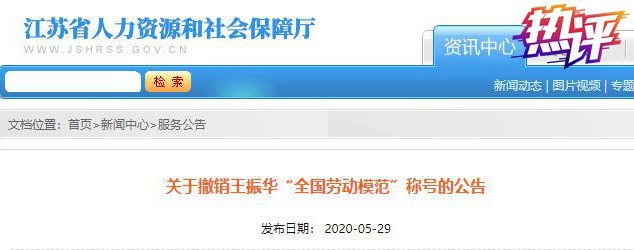
Hot comment: Wang Zhenhua has been revoked the title of national model worker. What do you think?

There is new news about Wang Zhenhua’s alleged child molestation. A few days ago, the Announcement on Revoking the title of "National Model Worker" in Wang Zhenhua issued by the Jiangsu Provincial Department of Human Resources and Social Security said that recently, Ministry of Human Resources and Social Security issued a decision to revoke the title of "National Model Worker" in Wang Zhenhua, withdraw its medals and certificates, stop the relevant treatment it enjoyed for winning the honor, and recover the material rewards such as the prize money it won.
As a well-known entrepreneur, Wang Zhenhua has won many honorary titles, such as "Jiangsu Model Worker", "National May 1st Labor Medal" and "National Model Worker". He was also a representative of Changzhou Municipal People’s Congress and a member of Shanghai Municipal People’s Political Consultative Conference.
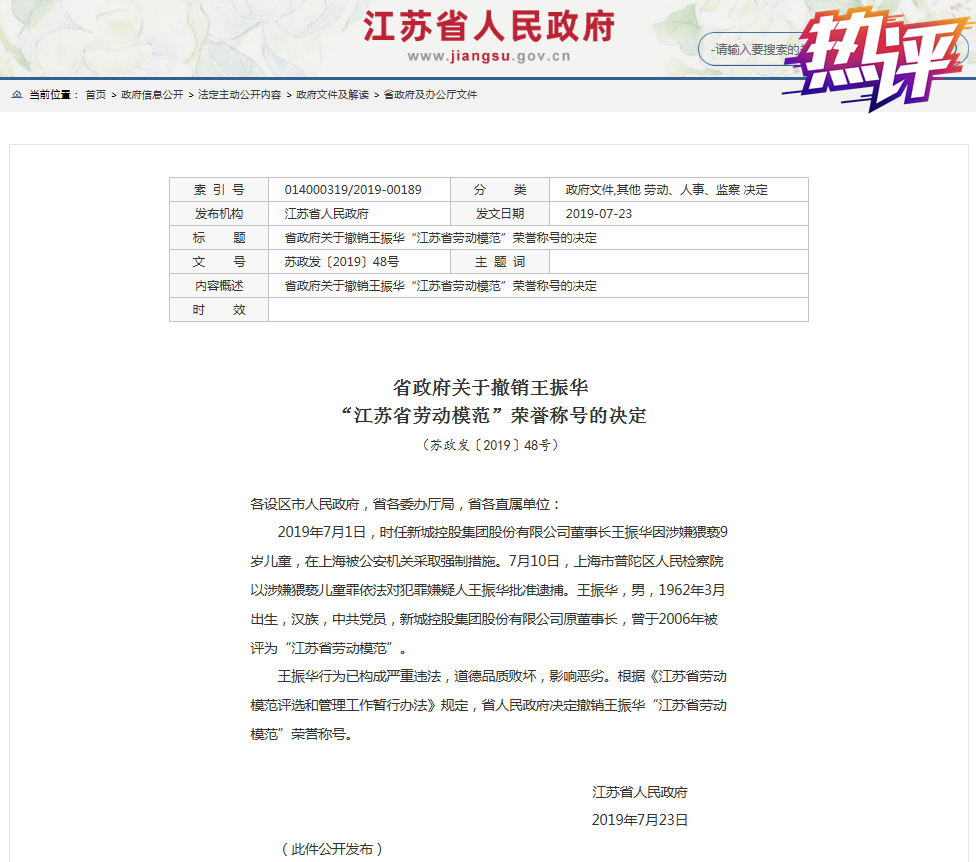
Wang Zhenhua’ s alleged child molestation case occurred on June 29 last year and was exposed on June 30; On July 1 last year, Wang Zhenhua was taken compulsory measures by the public security organs in Shanghai. On July 8 last year, the Shanghai CPPCC revoked Wang Zhenhua’s membership of the 13th Shanghai CPPCC. On July 10th last year, Wang Zhenhua was arrested on suspicion of child molestation. On July 23rd last year, the People’s Government of Jiangsu Province revoked Wang Zhenhua’s honorary title of "Model Worker in Jiangsu Province".
Nowadays, Wang Zhenhua has been revoked the title of "National Model Worker", which is not surprising at all. It is logical, legal and more in line with people’s hearts, which maintains the honor and seriousness of the title of model worker. As stated in the previous decision, Wang Zhenhua’s behavior has constituted a serious violation of the law, and his moral quality has deteriorated and his influence has been bad. According to the Interim Measures for the Selection and Management of Model Workers in Jiangsu Province, the People’s Government of Jiangsu Province decided to revoke the honorary title of "Model Workers in Jiangsu Province" of Wang Zhenhua. By the same logic, Wang Zhenhua does not deserve to continue to enjoy the honor of national model workers. No matter whether the medals and certificates are recovered or the bonuses are recovered, it is well-founded in the law.
It is worth mentioning that it has been nearly a year since Wang Zhenhua was suspected of molesting children. People have been paying attention to the progress of the case. Recently, many netizens are still asking whether Wang Zhenhua has been tried. The concerns of many netizens are in line with the people of the world. I still remember that when the Wang Zhenhua case was first exposed, public opinion was in uproar. It is tolerable for a well-known entrepreneur to do such a nasty thing! People still remember that the Shanghai police said at that time that they would "resolutely investigate to the end and fully ascertain the case" and "always hold a’ zero tolerance’ attitude towards crimes against minors and resolutely crack down on such crimes according to law".
What’s the progress of Wang Zhenhua’s alleged child molestation case? Waiting for the authority to respond. The indisputable fact is that the state is stepping up its crackdown on sexual assault on minors according to law. Just recently, the Supreme People’s Procuratorate, together with the State Supervision Commission, the Ministry of Public Security, the Ministry of Justice, the Ministry of Education, the Ministry of Civil Affairs, National Health Commission, the Central Committee of the Communist Youth League and the All-China Women’s Federation, signed and issued the Opinions on Establishing a Compulsory Reporting System for Cases of Infringement on Minors, stipulating that nine categories should be reported, such as sexual assault, abuse, bullying, and trafficking. If these situations are discovered, the relevant responsible subjects should report them. In order to stop crimes in time and effectively protect the legitimate rights and interests of minors, it is stipulated that "suspected" situations should also be reported. These regulations show the determination of the country.
There is a background that cannot be ignored. On June 1, the White Paper on the Procuratorial Work of Minors (2014-2019) issued by the Supreme People’s Procuratorate showed that 43,400 people were prosecuted for sexual assault against minors from 2017 to 2019, and the number of crimes against minors was on the rise. It is not difficult to judge that it is extremely necessary to establish a compulsory reporting system for cases against minors. In addition, it is necessary to build an effective mechanism of combining punishment with prevention, strengthen the protection of minors, on the one hand, build a safe barrier for minors, and improve their self-protection awareness; On the other hand, improve the fixed evidence in time, punish illegal crimes according to law, and make sexual abusers pay a heavy legal price.
The healthy growth of minors is related to the future of the country and the nation. At present, it is urgent to form a protection mechanism for minors with source prevention, timely detection, efficient emergency and punishment according to law. From this perspective, Wang Zhenhua’s deprivation of the title of "National Model Worker" is not the end. If he is convicted of child molestation, he will have to bear the corresponding legal responsibilities. Ruan Qilin, a law professor at China University of Political Science and Law, said in an interview with CCTV that according to the criminal law, those who commit child molestation will be sentenced to fixed-term imprisonment of not more than five years and severely punished. If it is found that people gather together or commit crimes in public places, or there are other bad circumstances, it shall be sentenced to fixed-term imprisonment of not less than five years.
At present, the construction of the rule of law is vast. Every fair precedent is a just act that stirs up confusion and clears up the Qing Dynasty, and it is also a solid cornerstone for shaping the public’s belief in the rule of law. Through the fair trial of a judicial case, it is also the profound connotation of the construction of the rule of law to deeply cast the spirit, consciousness and concept of the rule of law in the hearts of the public.
Therefore, we must not let justice be late, let alone absent. Responding to the voice of public opinion, facing up to the public’s desire for truth and expectation for justice, and promoting the progress of the rule of law through major case trials can not only fully demonstrate the effectiveness of comprehensively governing the country according to law and deepening judicial reform, but also make justice shine in the world, make criminals fear, and let the people gain a more real sense of the rule of law.
(Wen Yi Qin Chuan)
Reporting/feedback

Ministry of Industry and Information Technology: Sorting out the drug demand of key groups in old-age care institutions, schools and rural areas for medical treatment and drug use.

  Cctv newsOn the afternoon of February 27th, the State Council Joint Prevention and Control Mechanism held a press conference to introduce the situation of consolidating the major achievements in epidemic prevention and control, and to answer questions from the media.

  Zhou Jian, deputy director of the Consumer Goods Industry Department of the Ministry of Industry and Information Technology, said that the CPC Central Committee and the State Council attached great importance to epidemic prevention and control in key institutions and areas such as pension institutions, children’s welfare homes, schools and rural areas. The Ministry of Industry and Information Technology guides local medical material support groups to act quickly, strengthen docking, and ensure that the demand for medical treatment for key populations is given priority and strongly guaranteed.

  The first is to conduct a comprehensive investigation and judgment. We will sort out and summarize the drug demand of national pension institutions, schools and rural areas, form a list of key medical materials demand, and give key protection to ensure the effective protection of drug use for key groups.

  The second is to strengthen departmental coordination and resource docking. We will provide special dispatching support for epidemic prevention materials urgently needed by national pension institutions, child welfare institutions, mental health institutions and schools, and meet them comprehensively and quickly by organizing enterprises to donate peer-to-peer supply. We will focus on strengthening the medical supplies in rural areas, and basically equip township hospitals nationwide with oxygen meters and three kinds of drugs, namely "antipyretic, cough relieving and Chinese medicine".

  The third is to accurately launch the network platform. Give full play to the role of e-commerce platform, organize online supply and demand docking activities, and nearly 900 production enterprises and more than 1,600 circulation enterprises successfully docked; Promote the accurate delivery of medical materials, improve the efficiency of terminal distribution, and deliver a total of 162 million drugs, benefiting 76.85 million people, of which the area below the county level accounts for over 70%.

  Thanks to the efforts of all parties, the medical materials needed by 16,000 old-age care institutions, 198 child welfare institutions, 224 mental health institutions, local schools and rural primary medical institutions have been met in time and in full. In the next step, we will normalize the production and supply of medical materials, strengthen coordination with relevant departments, and meet the medical material needs of key institutions, key regions and key populations in a timely manner.

Chongqing: On August 24th, the nucleic acid test will be carried out in the central city, and it will be decided according to the situation.

  Cctv newsOn August 23rd, the leading group for epidemic prevention and control in novel coronavirus, Chongqing issued the Notice on Carrying out Nucleic Acid Screening in Central City.

  1. On Wednesday, August 24th, 2022, a round will be held for all citizens (including local permanent residents, temporary residents, temporary migrants, foreigners, etc.) in the central city of our city (Yuzhong District, Jiangbei District, Nan ‘an District, Jiulongpo District, Shapingba District, dadukou district, Beibei District, Yubei District, Banan District, Liangjiang New District and Chongqing High-tech Zone of Western Science City). Then decide whether to carry out the corresponding rounds of nucleic acid screening according to the situation.

  Second, in view of the current high temperature weather, the centralized sampling time is arranged in principle at 6— on the 24th; It will be carried out after 12 o’clock and 6 o’clock in the evening. If it has heatstroke prevention conditions, it can also be sampled in the rest of the time according to the needs of the citizens. All completed on the same day. According to the work arrangements of each district (administrative committee) and the organizational arrangements of streets (towns) and communities (villages), the citizens carry valid identity documents such as ID cards and foreign identity certificates or show their "Yukang code", and go to the nucleic acid sampling points in batches and in an orderly manner, so as to ensure that no one is left behind and no one is left behind, thus realizing "all inspections should be completed." The location of each sampling point shall be announced in the official website of the Health and Wellness Committee of each district (administrative committee) before 20:00 on August 23rd, and reprinted by official website of the Municipal Health and Wellness Committee.

  Three, organs at all levels, enterprises and institutions at all levels within the scope of the central city should urge cadres and workers to participate in nucleic acid sampling in time, and they can flexibly adopt flexible working or home office methods on the same day. For the relevant staff involved in nucleic acid sampling, detection and order maintenance, all districts (administrative committees) can make arrangements and take samples in advance.

  4. In order to ensure that all inspections should be completed, the "Yukang Code" of the citizens in the central city will be given orange pop-ups from 0: 00 on August 24 (the existing pop-ups, red codes and yellow codes of "Yukang Code" will remain unchanged), and the window will be automatically eliminated after completing the nucleic acid sampling once. The first day of pop-up window does not affect normal activities, and it is recommended not to participate in gathering activities. If nucleic acid sampling is not carried out, from the second day, no dinners, no meetings and business activities, and no public places with dense people and closed spaces are allowed.

  Five, the central city district (CMC) epidemic prevention and control work leading group is responsible for the organization and implementation of nucleic acid detection and screening in this area, strictly implement the responsibility, take heatstroke prevention measures to prevent the occurrence of high temperature heatstroke accidents, and give priority to the arrangement and care of the elderly and children. For people with special difficulties, such as elderly people living alone, disabled people and patients with chronic diseases, the staff will provide on-site sampling service, and please contact the community (village) staff in advance.

  6. The personnel in the designated temporary control zone, medium and high risk zone, and the isolated control personnel carry out nucleic acid detection according to the control requirements, which are not included in the scope of this nucleic acid detection.

  Seven, within 48 hours after the vaccination of Covid-19 vaccine, the personnel will not be arranged to participate in this nucleic acid test, and all districts (administrative committees) will make record statistics in advance and make proper arrangements for follow-up testing.

  Eight, to participate in nucleic acid sampling, please wear a mask, keep a distance of more than one meter, to prevent cross infection, high temperature heatstroke.

  Nine, please actively support the general public to cooperate with the nucleic acid screening work, do not panic, do not spread rumors, do not believe in rumors, do not spread rumors, refuse to cooperate with nucleic acid sampling without justifiable reasons, hinder the prevention and control of the epidemic, disrupt public order or cause other serious consequences, and will be investigated for their corresponding legal responsibilities according to law.

A mentor in a big country should have a big pattern, a big realm and great wisdom.

  On the 34th Teacher’s Day, the National Education Conference was held grandly, and the General Secretary of the Supreme Leader delivered an important speech. The congress has made scientific top-level design and careful deployment arrangements for education reform and development, put forward the goal of rallying people’s hearts, perfecting personality, developing manpower, cultivating talents and benefiting the people, and made clear the fundamental task of cultivating socialist builders and successors with all-round development in morality, intelligence, body, beauty and labor.

  Education is a national plan and a party plan. Education is the cornerstone of national rejuvenation and social progress, and it is a moral and political project that contributes to the present and benefits the future. "Xunzi Outline": "The country will prosper, and it must be expensive and heavy; If you are a teacher and pay attention to Fu, the law will survive. " "The foundation of goodness lies in teaching, and the foundation of teaching lies in the teacher". Teachers are the foundation of establishing education and the source of promoting education.

  On the element of teacher in education, the congress conveyed two basic messages. On the one hand, as an engineer of human soul, he is the inheritor of human civilization. Teachers bear the heavy responsibility of the times of "three communication" and "three shaping"; We should be strict with ourselves and constantly improve our professional creed, be persistent in teaching and educating people, love education, and be indifferent to fame and fortune. On the other hand, it is the need of party committees and governments at all levels, for which the previous Opinions of the Central Committee of the Communist Party of China and the State Council on Deepening the Reform of Teachers’ Team Construction in the New Era has been fully deployed. So what is the people’s teacher who is worthy of the great responsibility of the country and the great plan of the party? A great country teacher should look like a great country teacher.

  A good teacher in a big country should have a big pattern of being a teacher. In the new historical period of Socialism with Chinese characteristics’s development, it is an important task to cultivate builders and successors of socialism with Chinese characteristics with all-round development in morality, intelligence, physique and beauty. The completion of this great historical mission requires teachers to have a big pattern. First, teachers should care about the motherland and the people. The congress put forward that education should be people-centered. Teachers’ work is not just to meet their own needs. In the seemingly repetitive daily and tedious work day after day and year after year, teachers need to be mindful of the motherland, always remind themselves of the needs of social development, always remember the powerful responsibility of the motherland, and never forget the historical mission of realizing the great rejuvenation of the Chinese nation. Second, teachers should base themselves on the present and focus on the future. Education is a moral and political project that benefits the present and the future. Teachers train successors for the future, so we must focus on the future, the future situation changes and the future challenges, so that students can have innovation, responsibility and practical literacy that can meet the needs of future social development. Third, teachers should not only take root in China, but also look at the world. The congress put forward that education should be rooted in China. At the same time, China should stand tall among the nations of the world and truly move from a big education country to a strong education country. Teachers need to take a global view and grasp the trends and trends of world development, so as to cultivate students’ quality of adapting to globalization and internationalization.

  A good teacher in a big country should have a great realm of teaching. The whole church put forward that efforts should be made in six aspects: strengthening ideals and beliefs, cultivating patriotic feelings, strengthening moral cultivation, increasing knowledge and knowledge, cultivating the spirit of struggle and enhancing comprehensive quality. This requires teachers to have a big realm. First, there is no class for masters. This is the basic point and starting point of being a teacher. There is no difference between teachers’ care and love for their students, no blind spot, no forgotten dead corner, no matter what background, personality, achievements and characteristics they face. The second is to love without me. "Love without me will eventually become a big me; The heart of altruism will eventually become a great instrument. " The third is to do nothing, do nothing without doing anything, and do it without arguing. Quiet is quiet and inaction, while moving is natural. Be a teacher by example, let your mind be quiet and call back your original self. Get permanent success from just letting nature take its course.

  A good teacher in a big country should have great wisdom in educating people. Teachers bear the heavy responsibility of shaping the soul, life and new people. Teachers’ career of dealing with people is that one life affects another, which requires teachers to have great wisdom in dealing with people. One is to be childlike. With childlike innocence, teachers will really walk into students, really understand students, really understand students, only then will education be pure, noble and great, and only then will real education take place. The second is to have love. Without love, there is no education. "The knower enjoys water, and the benevolent enjoys Leshan. Those who know move, and those who are kind are quiet. Those who know are happy, and those who are benevolent are longevity. " Teachers must have love, love the cause of education, love the students as a group and love the work of teaching. The third is to have a normal heart. Normal mind means persistence in teaching and educating people, love and persistence in education, refusing utility, staying away from impetuousness, having a positive and sunny attitude, broad mind and an open career, so as to truly achieve the ultimate goal of cultivating people for a hundred years.

  (Li Xincui is an associate researcher at the Institute of Teacher Development of China Academy of Education)

Fuzhou Radio and TV Station

Fuzhou Radio and Television Station, under the management of the Propaganda Department of Fuzhou Municipal Committee of the Communist Party of China, is a department-level institution that implements enterprise management. There are 18 departments under the jurisdiction of Taiwan, and Fuzhou Radio and Television Media Group Co., Ltd. is wholly established, with more than 800 employees in Taiwan.

Fuzhou Radio and Television Station is the most authoritative and influential radio and television media in Fuzhou. Among them, the radio station has four frequencies: news broadcast (FM94.4), music channel (FM89.3), voice of traffic (FM87.6) and voice of Zuohai (FM90.1). The TV station has five channels: news integration, film and television, life, children and family shopping. At the same time, it also owns Cultural Life Newspaper and Fuzhou Pearl Network. In recent years, Taiwan has cultivated a number of radio and television brand columns with high ratings, such as Fuzhou News, News 110, Pan Lecture, Fa Yan, Liaozhai Night Talk, Life Zero Distance and Political Style Hotline.

In terms of technical equipment, Taiwan currently has Beifeng radio and television transmitting station, TV news media information system, Typhoon satellite live broadcast system, more than 10 TV studios (rooms) of 100-1,000 square meters, and 3 HDTV broadcast vans and satellite interview live broadcast vans. At present, the TV HD channel broadcast building is under construction, which basically realizes the digitalization and networking of radio and television editing and broadcasting technical equipment.

Can the university graduate after receiving the academic warning? Look at the college teacher’s response!

   CCTV News:Recently, South China University of Technology published an "early warning list of undergraduate studies in the whole school", which attracted attention. 737 students have received academic warnings, and more than 200 students are still facing demotion. In recent years, many colleges and universities are carrying out academic early warning mechanism. Previously, universities such as Shenzhen University of Technology and Guangdong Medical University also released similar academic early warning information.

  Under what circumstances will students receive an academic warning?

  Why should colleges and universities carry out academic early warning mechanism?

  What should the school do after the academic warning is issued?

  Solve the problem of students’ difficulty in completing their studies from the root

  What else can I do?

  What is academic warning? What is the "trigger condition"?

  Academic early warning is mainly a mechanism for the school to help students successfully complete their studies through warning, communication and some assistance measures for students who may or have already had learning problems, such as excessive absenteeism and frequent failure of classes. There are often two categories:

  Attendance warning:It is aimed at students who have been absent from school for no reason and accumulated close to or reached the prescribed hours.

  Performance warning:For students who fail more than a certain number of courses in a semester or school year.

  Many colleges and universities have their own regulations on academic early warning.

  South China University of TechnologyAccording to the regulations, students who fail to score more than 15 points will trigger an early warning. If they exceed 25 points, they will be demoted for trial reading, and those who fail to meet the standards again will be dismissed.

  Shenzhen University of TechnologyIt is to give academic warning to students whose total course credits obtained in the current semester do not reach half of the total credits of the courses selected in the current semester.

  University of Shanghai for Science and TechnologyIt is stipulated that students should complete 25 credits at the end of grade one, 60 credits at the end of grade two and 100 credits at the end of grade three and above. The academic affairs office gives academic warnings to students who fail to meet the requirements for the first time every academic year and sends "academic warning notices".

  Shanghai University Of Engineering ScienceAccording to the number of credits that failed the course each semester, the early warning is divided into three levels, two levels and one level.

  Shanghai Maritime UniversityIt is stipulated that students who fail more than 2 courses each semester and fail more than 9 credits will be given professional early warning.

  Academic early warning is nothing new, and there are relevant regulations.

  In fact, it is nothing new to warn students who have academic problems and may not be able to graduate. As early as 2019, the Opinions on Deepening the Reform of Undergraduate Education and Teaching and Improving the Quality of Personnel Training issued by the Ministry of Education proposed that colleges and universities should establish an academic early warning and elimination mechanism. Colleges and universities also began to explore immediately.

  What does it mean to receive an academic warning? What is the purpose of establishing this mechanism? Come and listen to the expert’s interpretation.

  Chu Zhaohui, a researcher at China Academy of Educational Sciences:Many subjects failed the examination, which is obviously an abnormal situation. As for the severity, it is mainly based on how many disciplines have problems to warn. The meaning of test scores in different subjects is different, but they should all attract students’ attention. If you don’t take measures, you may not be able to finish your studies, you may face demotion and you may face elimination.

  Chen Zhiwen, Academic Member of China Education Development Strategy Society:For example, I was supervised by my parents and teachers since I was a child, and then I went to the university to "herd sheep." And if you don’t want to learn, then truancy and failing classes are more common. If he is not a subjective attitude problem, he may have learned something that he is not good at. Many children blindly followed when volunteering for the college entrance examination, and even were misled into finding a good job in this major, and then applied for this major, but in fact he was not suitable at all. Let’s not wait until the students finally graduate, because too many students fail to get their diplomas, so we should constantly remind them at different levels. For example, if you fail 8 courses, you won’t have a diploma. When we fail 4 courses in advance, we will start to remind you. Synchronization often informs parents and forms a joint force to urge children to learn.

  Dynamic monitoring and accurate assistance to help students complete their studies

  The period of university education is relatively long, and the establishment of academic early warning mechanism also sends a signal that the monitoring of students’ academic situation in colleges and universities is more dynamic and normal, which runs through the whole process of students’ education and training.

  So what will the school do after issuing an early warning? Can students who receive early warning graduate smoothly?

  In Guangdong Medical University, the academic early warning system for undergraduate students has been implemented for more than three years. Over the past three years, nearly 100 students have received academic warnings. Among them,70% of the students successfully completed their studies through the assistance of the academic early warning system.

  Zhou Yanfang, Director of Academic Affairs Department of Guangdong Medical University:More is a kind of care. For example, in the earliest caring consultation, academic tutors and professional tutors communicated one-on-one to find some problems, such as study habits, learning ability or psychological pressure; Then some precise help strategies are carried out, including both academic help and psychological help.

  In University of Science and Technology Beijing, the school conducts academic research and judgment on students every semester, expands the scope of assistance to all students who fail classes, and carries out peer exercise classes and one-on-one counseling activities under the guidance of professional teachers. The counseling subjects cover mathematics, physics, chemistry and other disciplines.

  Gao Li, Deputy Director of Student Affairs Department, University of Science and Technology Beijing: We have divided the early warning mechanism of red, yellow and blue lines. If a student already has an academic warning or is about to face an academic warning, we should put him in the red line. If a student can’t finish 70% of the required course credits, we will put him in the yellow warning; All the students who fail the course, we should put them in the blue warning. Through early detection, early intervention and early treatment, I hope that he can get some outside counseling and support when he just fails.

  What else can be done to solve "learning difficulties"?

  Some college students become "families with learning difficulties" because of subjective factors, such as weak autonomous learning ability, and the school can give him targeted early warning assistance. However, some problems also exist objectively, such as being confused when applying for a major, or the course is not in line with expectations, which makes it difficult for students to complete their studies. In view of this kind of problem, what else can we improve in the teaching process?

  Chu Zhaohui, a researcher at China Academy of Educational Sciences:I think it should be reconsidered in education and teaching, not only after warning.

  In the first aspect,There are relatively many compulsory courses and relatively few elective courses in colleges and universities.So students have less choice space. Is it his favorite class? Is it valuable to his studies? In fact, different courses are different for different children.

  In the second aspect,The assessment of students, the implementation of the academic year system.Undergraduate courses must be completed within four years and five years, which is inflexible. For those students who haven’t realized the significance and value of learning, I think the school can consider implementing some flexibility. Because of the difference between the academic year system and the credit system, this may be somewhat difficult.

  The third one ismajor field. During the changes in the past few years, some colleges and universities have set up major transfer. But overall,There are still some obstacles to changing majors., especially in the case of academic problems, change majors. In the past, many schools changed their majors, but in fact, they had to get to the top of the grade before they could change.

  For those students who have early warning, we must understand and investigate their situation to make predictions, instead of saying that I have done my duty by giving early warning, so there will still be some new problems.

Historical changes and contemporary innovations of mainstream religious views in China

  The present situation of religion in China

  The change of the mainstream Confucian religious view in China’s history during the Republic of China from the founding of New China to the establishment and practice of the contemporary new religious view in 1956. The progress and mistakes of the national religious theory from 1957 to 1976, the innovation of the religious theory with China characteristics since the reform and opening up, and several cognitive problems in implementing the basic principles of the party’s religious work

  General Secretary of the Supreme Leader emphasized at the Central United Front Work Conference that ethnic work and religious work are all overall work. Religious work is essentially mass work. We should fully implement the party’s policy of freedom of religious belief, manage religious affairs according to law, adhere to the principle of independence and self-management, and actively guide religion to adapt to socialist society. To actively guide religion to adapt to the socialist society, we must adhere to the direction of China, improve the level of legalization of religious work, treat the social role of religion dialectically, pay attention to the role of religious figures, and guide religious efforts to serve the promotion of economic development, social harmony, cultural prosperity, national unity and the reunification of the motherland. The speech highly summarized the importance of religious work and the connotation of the Party’s principles and policies on religious work, especially expounded the four "musts" of actively guiding religion to adapt to the socialist society, and first emphasized that "we must adhere to the direction of China", which was very meaningful. This is not only the latest incisive summary of the religious work experience since the founding of New China, but also contains the historical wisdom of Chinese civilization in dealing with religious issues.

  ?

  ?

  ?

  The mainstream Confucian religious view in China’s history

  Historically, the mainstream society and politicians in China have been mainly guided by Confucian views on religion. Confucius famously said, "Stay away from ghosts and gods". He is not keen on the way of ghosts and gods, but he takes a "respect" attitude towards the religious beliefs of ordinary people. Ceng Zi, a student of Confucius, said, "Be cautious in pursuing the future, and people’s morality will return to thick.". Pursuing the distance carefully is ancestor worship, whose function is to make the moral fashion of ordinary people simple and honest, which is the moral function of religion today. Later, Yi Zhuan summarized this function as "teaching by Shinto", which means that the way of ghosts and gods is regarded as a means of moral education. This is the attitude of Confucianism towards religion. Under the influence of Confucius, the mainstream society in China is "moderate" towards religion. Although China’s dynasties were autocratic politically, they were pluralistic and inclusive in cultural and religious policies. After Buddhism and Islam were introduced into China, their contents and forms changed. For example, Zen Buddhism appeared in China, advocating human Buddhism; Chinese Islam does not pursue the unity of politics and religion, and its exclusiveness is greatly weakened. Is Confucius’ thought a religion? My point of view is that Confucianism is basically not a religion, but an ethical anthropology in the East, because Confucius does not talk about the problem of afterlife and ghosts and gods, and the view without gods and the other side cannot be called religion. Confucius spent his whole life talking about how to be a man and how to govern the country."University" summed up these views as: self-cultivation, keeping the family in order, governing the country and leveling the world. Confucius was a thinker and educator, not a religious teacher. Of course, Confucius’ thoughts are also religious, for example, "fearing fate" and attaching great importance to religious sacrifices.

  In addition, Confucianism says that "harmony is precious", "harmony is different" and "Tao is parallel but not contradictory", and the concept of harmony is the most abundant in Confucianism. This has enabled China to accommodate many religions. After Wei and Jin Dynasties, Confucianism, Buddhism and Taoism came into being in parallel and multi-religious coexistence. Buddhism spread to China, there are objections, but the mainstream of society is accepted; After Taoism flourished, there was room for its existence. Later, Christianity and Islam also spread to China and became a part of China’s multi-religions. As long as the relevant religions are patriotic, law-abiding and good-advised, there is a reasonable and legal space for their existence in China. Because the mainstream Confucianism in China is tolerant and moderate, there are many religious categories in China, which is rare in the world. The world’s three major religions and their main sects have spread in China, as well as ethnic religions such as Taoism, as well as a large number of folk religions and various primitive worship, so some people say that China is the "United Nations of religions". Today, there are five religions in China, namely Taoism, Buddhism, Islam, Christianity and Catholicism. Except Taoism, the other four religions are foreign religions, which shows the inclusiveness of China’s religious culture. Harmony is the main theme among religions. You have me and I have you. The doctrines of various religions are moderate, and extremism is difficult to develop. In the long-term historical development, religions in China have formed a profound and fine tradition.There are mainly: patriotism and love of teaching are highly unified, with doing good deeds as the first meaning, advancing with the times, being brave in innovation, symbiosis and mutual prosperity, mutual respect and learning, politics leading and teaching assisting, teaching not doing politics, culture promoting and civilized exchanges, national subject, and internal and external integration. For more than 2,000 years, Chinese has had a universal basic belief, that is, to respect the ancestors of heaven and law, but it does not exclude other religions. The core of China’s belief culture is Confucianism, Buddhism and Taoism. Confucianism is not a religion, but it plays the role of western Christianity. When Buddhism entered China, it successfully connected with Confucianism and Taoism, and there was Zen Buddhism in China. China’s Islam has also made great achievements in the direction of China. The China process of Christianity in China (in a broad sense) is facing various difficulties, but it is also advancing steadily. In the history of China, religions have basically maintained peace and harmony. There is no religious war or inquisition, and they can become good neighbors. Although there were frictions, there were also "three martial arts and one incident" to destroy the Buddha, but the duration was short, and religious confrontation could not become a tradition. In history, religion has never created a huge obstacle to social reform and progress, but it is a kind of help.

  Changes of mainstream religious views in the Republic of China

  Since modern times, the religious view of mainstream society in China has changed, and the treatment of religion is no longer moderate and inclusive, but radical and negative, especially after the Revolution of 1911, religion has been constantly impacted. This is because China’s modern society is relatively backward and has suffered too much humiliation from the West. In order to liberate and revitalize the country independently, people think that China’s culture lacks democracy and science, so they should learn from the West and save the country with science and democracy. China needed democracy and science, but scholars in the Republic of China didn’t see that when the West developed democracy and science, Christianity was not replaced, but reformed it to serve modernization. At that time, the theory of "religious substitution" was popular in academic circles, arguing that there was no religious position in China’s future cultural construction. Cai Yuanpei proposed aesthetic education to replace religion, Chen Duxiu and Hu Shi proposed science to replace religion, Liang Shuming proposed ethics to replace religion, and Feng Youlan proposed philosophy to replace religion. So at that time, people ignored the study of religion. During the period of the Republic of China, Buddhism and Taoism were also proposed to "develop learning through temple property", and the National Government confiscated many temple properties. In fact, it looked down on Buddhism and Taoism and wanted to restrict it. At the same time, a "non-Christian movement" took place, totally denying Christianity, with a fierce attitude. At that time, the mainstream of academic circles was dominated by scientism and belittled religion on the grounds of "unscientific". In fact, the major religious subjects performed well in War of Resistance against Japanese Aggression and the democratic revolution, which is commendable.

  从新中国成立到1956年当代新宗教观的建立和实践

  这一时期的宗教观体现了唯物史观与中国实际的结合,理论上有所创新,政策健康,实践成果辉煌,是新中国宗教工作的黄金时期。中国共产党在革命年代确立的民族平等和尊重保护宗教信仰自由的政策,新中国成立之后不仅继承下来,而且加以发扬。尤其在和平解放西藏、进军新疆、实现全国统一的过程中,解放军和党的干部忠实执行民族宗教政策,起了关键作用。1951年5月,毛泽东对主持西藏工作的张国华说:“你们在西藏考虑问题,首先要想到民族和宗教这两样事,一切工作必须慎重稳进。”从而“慎重稳进”成为党处理民族宗教问题的基本方针。十七条协议明确规定:实行宗教信仰自由政策,保护喇嘛寺庙,尊重西藏人民的宗教信仰自由和风俗习惯。1952年10月毛泽东接见西藏代表团时说:“共产党对宗教采取保护政策”,“今天对宗教采取保护政策,将来也仍然采取保护政策。”由于民族宗教政策符合马克思主义和中国国情,特别是能够对藏传佛教和伊斯兰教加以正确对待,在短时间内,中国顺利实现了统一大业(台湾除外),It ended the unstable and turbulent state in Xinjiang, Tibet and other ethnic areas that existed for a long time because of imperialist intervention and the corruption and incompetence of the old China government. The national feelings were unprecedentedly harmonious and the construction industry developed rapidly.

  In terms of Christianity and Catholicism, it is mainly to carry out anti-imperialist patriotic movements, eliminate imperialist forces and influences, and establish patriotic church groups run by China Christians, such as the Christian "Three Self" Patriotic Association and the Catholic Patriotic Association. Buddhism and Taoism in Han Dynasty mainly get rid of the influence of feudal system, advocate self-reliance and participate in social construction.

  From the perspective of how to treat and deal with religious issues, the mainstream religious theory and practice at that time can be summarized into two theories, namely, the theory of five natures and the theory of United front. On behalf of the Central Committee, Comrade Li Weihan, then head of the United Front Work Department of the Central Committee, put forward the theory of five religions: mass, long-term, complexity, nationality and internationality. Religion is not only regarded as a world outlook and spiritual culture, but also fully seen the social attributes of religion, which is a living social force and social culture with great influence and stability. Therefore, religious work must not be simplified, but should be taken seriously. The mass nature of religion makes us understand that the attitude towards religion is the attitude towards believers, which must be respected and cannot be forced to order. The long-term nature of religion makes us consciously overcome impatience and not regard religion as the remnants of old culture and rush to destroy it, because the roots of religion will exist for a long time and religious work must make long-term plans. The complexity of religion requires us to understand the multiple structures and diverse forms of religion itself, its multi-faceted relationship with social politics, economy and culture, and the duality of its social functions. Only by fully studying and understanding it can we do a good job in religious work. The nationality of religion tells us that religious issues are intertwined with ethnic issues. In China, religious issues are an important part of ethnic issues, and religious work is related to national unity and national unity. The internationality of religions makes us pay attention to the transnational influence of the three major religions in the world and the international communication of religions.由此宗教工作与中国的外交事业联系起来。统战论是中国共产党处理与宗教界爱国人士关系的方针。鉴于中国宗教界大多数在革命与建设中有良好表现,故中国共产党把宗教界作为团结对象,是朋友不是敌人。

  1957年至1976年民族宗教理论的进展与失误

  这一时期,民族宗教工作在理论与实践上既有开拓,也有失误和倒退。毛泽东在1957年发表的《关于正确处理人民内部矛盾的问题》中指出:“我们不能用行政命令去消灭宗教,不能强制人们不信教。不能强制人们放弃唯心主义,也不能强制人民相信马克思主义。”他肯定了宗教信仰是思想问题和人民内部问题,不能用强制方法解决。这一时期强调宗教信仰自由政策并明确反对用行政命令消灭宗教,坚持了马克思主义宗教观。

  从1957年反右派斗争起,经过1958年大跃进,到1962年反右倾斗争,强调千万不能忘记阶级斗争,再到1963年起开展的“四清”运动,“左”倾思潮逐渐抬头,民族宗教领域不断受到冲击。一是强调“民族问题实质是阶级问题”,把民族宗教领域阶级斗争扩大化。二是大量关闭拆除宗教寺庙,有些地方粗暴限制宗教正常活动。三是坚持正确路线的李维汉同志遭到批判,造成思想混乱,民族宗教工作开始走偏。

  1966年至1976年“文化大革命”时期,领导人错误地贯彻“以阶级斗争为纲”的路线,各项工作包括民族宗教工作遭到全面破坏,宗教活动停止,宗教场所和文物被大量毁坏,宗教界人士被当作“牛鬼蛇神”遭到横扫和迫害。这是中华民族的一场大浩劫,也是民族宗教领域的一场大灾难。

  改革开放以来中国特色宗教理论的创新

  改革开放后,我们进行了反思,认为“文革”的做法完全违背了马克思主义。恩格斯说:“一切宗教都不过是支配着人们日常生活的外部力量在人们头脑中的幻想的反映,在这种反映中,人间的力量采取了超人间的力量的形式。”他指出了宗教存在的深刻根源,因此反对向宗教宣战。这种唯物史观是马克思主义宗教观的理论基石。

  By bringing order out of chaos, religious work has returned to the Marxist track. There are the following signs:

  One is the 19th Document in 1982, which summarized the experience and lessons of the Party and the government on religious issues and pointed out that religion will exist for a long time in socialist society. After religion entered the socialist society, its functions have undergone fundamental changes, mainly contradictions among the people; The fundamental task of religious work is to unite religious people with non-religious people and devote themselves to socialist modernization. This is our party’s new understanding of religion.

  Secondly, in 1993, the Central Committee proposed "actively guiding religions to adapt to socialist society". I think the theory of religious adaptation is of great significance. It is the first positive affirmation that religion and socialist society have something in common and can adapt to each other, which is a new development of Marxist religious view.

  Thirdly, since the 21st century, the central government has proposed to give full play to the positive role of religion in building a harmonious society, emphasizing the theory of building religious harmony, and giving full play to the positive role of religious figures and believers in promoting cultural prosperity and economic and social development. As a result, religious culture theory, religious harmony theory and religious promotion theory rose.

  宗教文化论阐述宗教的文化属性和功能,揭示了宗教满足人们心灵情感需求的深层本质,展示了宗教在精神文化领域影响社会的特殊作用,为引导宗教健康发展和更好地适应当代社会开辟了广阔的空间。

  宗教和谐论是对前苏联式宗教斗争论的反思与超越,也是对中华宗教文化多元和谐传统的继承和发展,同时体现科学发展观以人为本、全面协调、统筹兼顾的要求,推动宗教多元平等、和谐共生、政教协调、文明对话,促进民族团结、社会稳定、和平发展,成为引导宗教关系走向的主要理论。

  而宗教促进论则表现出主流社会对宗教界的尊重和信任,突出信教群体的主体地位,从而有益于发挥宗教界人士的积极性主动性。从中我们可以看出,党的宗教理论和宗教政策发展有阶段性,随着改革开放的进展,向着更开放、更现代、更文明的方向发展。

  宗教的社会作用有其两重性,但是完全可以通过引导,尽量缩小消极作用,充分发挥积极作用,这正是习总书记所強调的“必须辩证看待宗教的社会作用”。今天,主流社会的宗教观是社会主义与中华文明的有机结合,因此才有民族宗教关系的和谐。

  贯彻党的宗教工作基本方针的几个认识问题

  第一,贯彻宗教信仰自由政策与温和无神论。保护宗教信仰自由是宗教工作基本方针中最重要、最根本的一条,现在我们已经把它提到了尊重和维护人权的高度。外国有人说中国共产党是无神论政党,中国社会主义意识形态是无神的,共产党不可能贯彻宗教信仰自由政策。我认为这里面有很多误解和偏见。无神论有多种。十八世纪法国战斗无神论影响很大,有其历史功绩,但其哲学是旧唯物论,不了解宗教存在的根源和发展规律,简单否定和激烈反对宗教,认为宗教是“傻瓜遇到骗子的产物”。而马克思主义者应该是温和的无神论者,不会人为地去消灭宗教;同时,维护群众的权益,其中就包含选择信仰的权益。我们真心实意维护宗教信仰自由,它是社会主义思想体系所决定的,是社会主义宗教观、民主观、平等观所决定的。我们是唯物史观支持下的无神论,它不信神,但能尊重别人的宗教信仰,这是它高于战斗无神论的地方。因此社会主义者应该是宗教信仰自由政策最坚定的维护者。“信仰上互相尊重,政治上团结合作”,体现了温和无神论的平等、包容精神。

  Second, manage religious affairs and normalization of religious affairs according to law. This is what is needed to establish a modern democratic and legal country. In the past, we used to manage religious affairs by administrative means or by relying solely on policies. In the future, we will change to manage religious affairs according to law. First, religious legislation should be improved, second, the concept of legal system should be strengthened, and third, the law enforcement system should be complete. Our legal system is still not perfect. At present, the Regulations on Religious Affairs promulgated in the State Council is a comprehensive national administrative regulation, which needs to be improved. Managing religious affairs is not interfering in the internal affairs of religious circles, but managing affairs related to public interests and national interests. The purpose of management is to protect normal and legal activities, stop illegal activities and crack down on criminal activities. At present, management is undergoing two changes: from direct administrative management to indirect management according to law, and from preventive abnormal management to service-oriented normal management. "Protection, management, guidance and service" advocated by the State Bureau of Religious Affairs is the essence of management.

  Third, adhere to the principle of independence and self-management and the localization of religion. This mainly deals with Catholicism and Christianity. Historically, after the Opium War, Catholicism and Christianity were indeed under the control of imperialism, and they once became tools for western powers to invade China. Today, western hostile forces are still using religion to try to evolve China’s regime. Therefore, it is very important to emphasize independence and self-management. We should make Catholicism and Christianity a cause run by patriots in China. This is not only conducive to safeguarding our national dignity and national sovereignty, but also conducive to the healthy development of Catholicism and Christianity. On the premise of independence and self-management, on the basis of mutual respect, equality and mutual benefit, we will carry out international friendly exchanges in religion, actively participate in world religious dialogues and civilized dialogues, and promote world peace and development. We should not only be independent in educational affairs, but also absorb Chinese culture and thoughts, build theology with China characteristics, make Catholicism and Christianity China, and make our own way in doctrine.

  Fourth, actively guide religion to adapt to socialist society and multi-dimensional guidance. Adaptation is multi-level and multi-faceted, and it can’t just be satisfied with patriotism and law-abiding. It is adaptation at the legal and political levels. At the same time, it should be carried out in an all-round way economically, culturally and socially. Adaptation is a two-way street — — Religious circles should adapt to our socialist society in the process of modernization; Our cadres and scholars also have a problem of re-learning, re-understanding the function of religion and actively guiding religion to adapt to socialist society. Now is the most relaxed historical period for the normal existence and activities of religions in China. The teaching community should establish a healthy teaching style, strictly observe the religious rules, build a good teaching staff, inherit and carry forward the Chinese spirit of benevolence, tolerance and harmony, stay away from and resist extremism, provide better services to the society in its own way, and live up to this great era and the ardent expectations of the party, the government and all walks of life for the religious community. Academic circles should continue to participate in the construction of Socialism with Chinese characteristics’s religious theory, which is our responsibility and responsibility.

Health insurance management measures revised again. Genetic test results cannot be used for insurance.

  Genetic test results cannot be used for insurance.

  Would you like to have an uncomplicated genetic test so that you can know your chances of developing lung cancer at the age of 50? If this test result will be used in your insurance underwriting, will you agree? I’m afraid it depends on the result.

  Genetic testing, which sounds like a high-tech means, is actually not far from people. Many insurance companies have tried to "buy insurance to send genetic testing". However, there are two sides to everything. Perhaps, because you carry a highly pathogenic gene of a disease, you will pay special attention to or buy a health insurance. But perhaps, the results of genetic tests will affect the rate at which you buy insurance — — Even if you carry a highly diseased gene, it will not break out for a lifetime.

  This week, the China Insurance Regulatory Commission revised the management measures for health insurance, and is in the period of soliciting opinions. It is mentioned for the first time that when an insurance company sells health insurance products, it is not allowed to illegally collect and obtain genetic information and genetic testing data of the insured except family medical history; Nor may the applicant be required to provide it. An insurance company shall not take genetic information and genetic testing data other than the family medical history of the insured as underwriting conditions.

  Buying insurance and testing genes is a double-edged sword.

  As we all know, suffering from diseases has a considerable relationship with the genes carried by human beings. In the past, genetic testing was regarded as a great technology, far from ordinary people. Now, you only need your saliva or a very small amount of blood to detect more than 50 diseases, including cancer, cardiovascular disease, Alzheimer’s disease and other gene-related diseases stipulated by the official critical illness insurance. The cost is only about 5,000 to 20,000 yuan. Even if you only look at a certain disease, the price of genetic testing can be achieved within 1,000 yuan.

  In the era of big data, genetic testing is of unusual significance to insurance companies. Many insurance companies have cooperated with testing institutions to reduce the original expensive expenses so that ordinary people can also do genetic testing. This kind of "buy insurance and send genetic testing" product has been controversial since it entered the market. Among them, it involves not only ethics and privacy, but also policies and regulations.

  For insurance companies, obtaining the genetic information related to the insured’s disease will make the level of risk controllable. For the insured, on the one hand, they want to know their genetic status, so as to judge whether to buy an insurance; On the other hand, they are worried that if the insurance company obtains its own genetic information, it will be refused insurance or raise the premium.

  Genetic testing is a gray area.

  You only need to scrape the epidermis on your mouth to know your risk probability of breast cancer in the future. This kind of "buy insurance and send genetic testing" is an innovative insurance, and it is also the initial stage of cooperation between insurance institutions and genetic testing institutions. The greater significance behind it is that genes containing a lot of body information are the most coveted big data in the insurance industry as a whole, and insurance companies can make more accurate risk pricing based on this database.

  The person in charge of a large domestic life insurance company explained the genetic testing as follows: genetic testing can be used as the starting point of health management, and can provide targeted follow-up health management services according to the test results of customers. The results of genetic testing determine what kind of health services will be provided to customers in the future, and at the same time, a huge amount of health data can be obtained. At the same time, more accurate pricing can also be completed. However, to a certain extent, this is the adverse choice of insurance companies, and the principle of good faith has always been mutual.

  The person in charge of this life insurance company told the reporter that a related case was reported abroad. A woman bought long-term care insurance after she found that the genetic test for the risk of Alzheimer’s disease was positive. Previously, the insurance company had tested her memory three times, and no abnormality was found in the genetic test.

  If you are forced to test your genes, your concerns about the insured are more obvious. In addition to refusing insurance, privacy also has to be worried.

  The new regulations prohibit the use of genetic testing for insurance.

  China has always been in a vague area for genetic testing to be used in insurance. The new health insurance regulations in the consultation period explicitly mention for the first time: insurance companies selling health insurance products shall not illegally collect and obtain genetic information and genetic testing data of the insured except family medical history; Nor may the applicant be required to provide it. An insurance company shall not take genetic information and genetic testing data other than the family medical history of the insured as underwriting conditions.

  Xia Ruxue, deputy general manager of the actuarial and big data department of Ping An Health Insurance, said that this move can completely block some companies or products from illegally collecting and obtaining the genetic information and genetic testing materials of the insured except family medical history in the name of genetic testing, or using genetic testing as a gimmick. "If the new regulations are officially promulgated, the related genetic testing insurance products on the market may undergo a wave of compliance adjustment".

  The reporter learned that in many countries, whether genetic testing can be used for insurance has been controversial for many years. In order to minimize the negative impact of genetic testing technology on insurance, many countries have passed corresponding laws to guide it. Some countries prohibit the use of genetic testing results to some extent, some do not intervene, and some have a discussion period for several years before the laws are really passed, thus protecting both the insured and the insured, and safeguarding the interests of insurance companies.

  What changes will the new health insurance regulations bring?

  ■ Long-term health insurance rates may be adjusted.

  "Insurance companies can float the short-term health insurance rate, and the range does not exceed 30% of the benchmark rate; The insurance company may stipulate in the insurance products that the rate of long-term health insurance products shall be adjusted, and clearly indicate the trigger conditions for the rate adjustment. " This provision in the Opinion Draft means that it is possible to adjust the rate of long-term health insurance in the future.

  The so-called long-term health insurance mainly refers to two products: one is health insurance with an insurance period of more than one year, and the other is health insurance with a guarantee renewal clause, although the insurance period does not exceed one year.

  Guaranteed renewal clause refers to a contract in which the applicant applies for renewal of insurance before the expiration of the previous insurance period, and the insurance company must continue to underwrite according to the original clause and the agreed rate. To put it simply, the insurance company promises that the insured will underwrite according to the original terms and agreed rates every time he renews his insurance.

  At present, the long-term health insurance rate is unchanged. In terms of critical illness insurance, consumers have bought a long-term critical illness insurance, and the premium paid every year is the same. According to the new regulations, if the rate of long-term health insurance can be adjusted, it means that the annual premium paid by consumers may be different, and it may rise in the future.

  ■ Information sharing between insurance companies and medical institutions

  One of the highlights of the exposure draft is to increase the content of cooperation between health management services and medical insurance, encourage insurance companies to combine health insurance products with health management services, provide health risk assessment and intervention, and provide services such as disease prevention, health examination, health consultation, health maintenance, chronic disease management and health care, so as to reduce health risks and disease losses.

  However, the exposure draft makes it clear that "health insurance products provide health management services, and their shared costs shall not exceed 20% of the net insurance premium". Services exceeding the above limits shall be priced separately, not included in the insurance premium, and the price of health management services shall be clearly stated in the contract.

  According to the exposure draft, under the premise of fully protecting customer privacy and data security, insurance companies are encouraged to realize information interconnection and data sharing with medical institutions and basic medical insurance departments. In this regard, some professionals pointed out that breaking data barriers is an urgent task for insurance companies to cooperate in medical insurance business. With the subsequent information interconnection and data sharing, medical insurance and commercial insurance cooperation may have more to do.

  Our reporter Fu Yang

Qi Rui xing tu xing Ji yuan ET automobile is the world’s first Contemporary Amperex Technology Co., Limited Shenxing rechargeable battery, which was listed in the first quarter.

On February 20th, Chery Automobile officially announced today that its Star Road Star Era ET car will be the world’s first rechargeable battery in Contemporary Amperex Technology Co., Limited Shenxing, claiming that it will take 10 minutes to charge, and Shenxing will travel 400 kilometers.

Star Road Star Era ET is positioned as a medium and large SUV, which adopts Chery NP 2.0 technology battery pack, providing different versions of capacity of 60kWh, 82kWh and 100kWh. The cruising range covers 500-700km, and the battery life can be supplemented by 150km after charging for 5 minutes. .

The first batch of mass-produced cars of Qi Rui Xing Tu Xing Ji Yuan ET was officially launched in Wuhu, Anhui Province in January. This is the second model of Xing Ji Yuan brand and the first pure electric SUV model. It is expected to be launched in the first quarter of this year.

In addition, it has a pure battery life of 200km and a comprehensive battery life of over 1500km.

Contemporary Amperex Technology Co., Limited Shenxing rechargeable battery is equipped with super-electronic net anode technology, graphite fast ion ring cathode technology, ultra-thin SEI membrane, ultra-high conductivity electrolyte formula and high porosity isolation membrane, claiming that the total battery life can reach 700 kilometers.