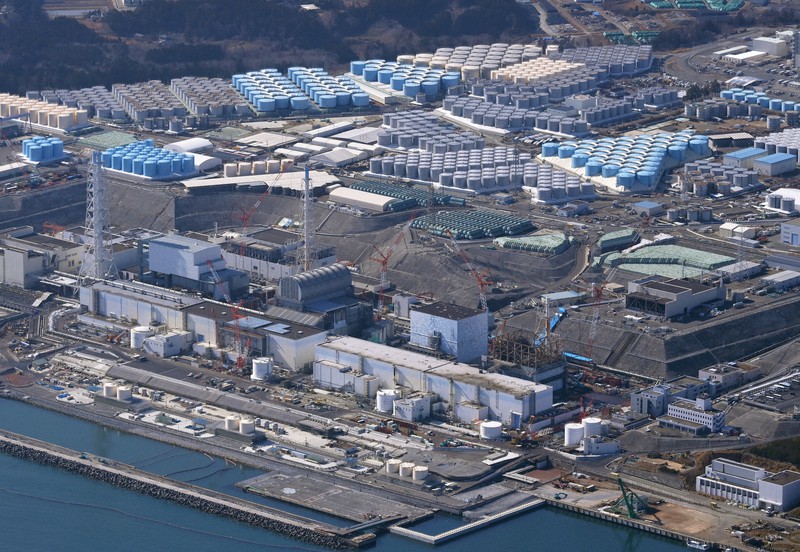
Fukushima Daiichi nuclear power plant filled with nuclear waste water storage tanks. (Photo/Daily News)
According to Asahi Shimbun, the Japanese government held a cabinet meeting on April 13th, and formally decided to discharge nuclear waste water from the Fukushima Daiichi nuclear power plant which is harmful to the marine environment. Zhao Lijian, spokesman of the Japanese Ministry of Foreign Affairs, said at the press conference on April 12 that "China should be responsible for the international public interest, which is also responsible for the interests of its own people." The Japanese government’s decision to discharge nuclear waste water into the ocean obviously lacks a highly responsible public spirit, which is not only detrimental to the marine ecological environment, but also threatens the common security and interests of neighboring countries and even the international community.
The nuclear waste water that the Japanese government decided to discharge into the ocean this time originated from the Fukushima nuclear leak 10 years ago. On March 11th, 2011, a 9.0-magnitude earthquake occurred in the northeastern waters of Japan, which triggered a tsunami, resulting in nuclear leakage at the Fukushima Daiichi nuclear power plant, and core meltdowns occurred in three reactors. In order to cool the damaged core, the Fukushima Daiichi nuclear power plant had to inject a lot of seawater. These seawater and a large amount of groundwater and rainwater infiltrated into the reactor form nuclear wastewater, which is packed in special water storage tanks. According to "Tokyo News" reported on April 9, the Fukushima Daiichi nuclear power plant adds 140 tons of nuclear wastewater every day. At present, the total amount of nuclear wastewater exceeds 1.25 million tons and there are more than 1,000 water storage tanks. According to the Japanese side, by the autumn of 2022, the storage tank for storing nuclear wastewater will reach the upper limit, so the Japanese government is eager to deal with it.
Obviously, the Japanese government has not really paid attention to the voice of opposition at home and abroad. In June 2016, an expert meeting organized by the Japanese government proposed five ways to treat nuclear wastewater, including dumping into the ocean and burying underground.It is not that there is no other way to treat it, but dumping it into the ocean is the lowest cost and the least time-consuming, so the Japanese government has been seeking to treat nuclear wastewater through this way, but up to now, the Japanese government has not won the support of public opinion at home and abroad.For example, a poll released by Asahi Shimbun on January 3 this year showed that 55% of the respondents "opposed" dumping nuclear wastewater into the ocean; Japan’s National Fisheries Organization and local people in Fukushima Prefecture have also held protests many times in the past few years, arguing that discharging nuclear wastewater into the sea will have a serious impact on agriculture, forestry and aquatic products around Fukushima. In addition, five United Nations human rights experts issued a joint statement on March 11th, warning that "discharging nuclear waste water into the sea will increase children’s health risks, which is equivalent to human rights violations." A spokesman for the South Korean Foreign Ministry said at a press conference on April 12 that Japan’s discharge of nuclear waste water into the sea "will have a direct or indirect impact on the Korean people and the surrounding environment". Greenpeace, an international organization that has long been committed to protecting the environment, has repeatedly urged the Japanese government to be cautious in dealing with nuclear wastewater. Obviously,The Japanese government’s official decision to discharge nuclear waste water into the sea today not only lacks a solid public opinion base at home, but also is widely criticized and questioned overseas, which is undoubtedly detrimental to others.
It is true that the Japanese government has repeatedly stressed that the nuclear waste water discharged into the ocean is "treated" and "meets the corresponding standards", but the Japanese government obviously ignores that the impact of nuclear pollution is long-term and unknown.Japan, which often defines itself as "the only victim of nuclear weapons in the world", knows that the impact of nuclear pollution on human beings and the natural environment is long-lasting, especially many sequelae and side effects are difficult to completely eliminate even after more than ten years.The impact of nuclear wastewater on global fish migration, human health, offshore fishing and ecological security is unpredictable. For example, Minamata disease caused by industrial wastewater discharge pollution occurred in Japan in the 1950s. At that time, the Japanese thought that industrial sewage could be diluted by the ocean, but the result was that industrial sewage was not diluted by the ocean, but it also led to serious physical obstacles, mental disorders and even death of people near Minamata Bay in Kumamoto Prefecture. Today, the Japanese government promises that the nuclear waste water discharged into the ocean will "meet the standards", but who can guarantee that similar Minamata disease will not happen in the future? What’s more, the Minamata disease was only concentrated in some parts of Japan, and the nuclear waste water discharged into the ocean would spread to the whole Pacific Ocean and have a huge butterfly effect. It can be said that the Japanese government’s discharge of nuclear waste water into the sea is not a simple internal affair of Japan. After all, its impact has already crossed national boundaries and will "radiate" the public safety and interests of neighboring countries and even the international community. Obviously, the Japanese government needs to uphold a responsible attitude towards its own people, neighboring countries and the international community, and thoroughly evaluate the possible impact of discharging nuclear waste water, instead of making hasty decisions.
Since joining the United Nations in 1956, Japan has been committed to building itself into a "responsible big country". Obviously, dumping domestic nuclear waste water into the Pacific Ocean is not only not the proper performance of a responsible country, but also will lower Japan’s credibility and image in the international community. On the issue of nuclear waste water treatment, Japan should not willfully "throw it all away", but should handle it carefully and properly to ensure the joint participation of all parties concerned to avoid further damage to the marine environment, food safety and human health. (Chen Yang)
Copyright works of overseas networks may not be reproduced without authorization.