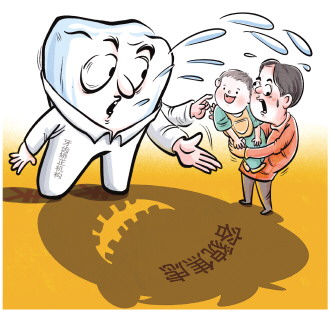
● In some cities, children’s dental chain clinics can be seen everywhere, and correction at a young age has become a common practice. Some clinics even recommend that children aged one and a half wear braces. They claim that "the earlier the dental deformity is treated, the lower the cost of time and money will be, and it will basically not recur when they grow up."
● Correcting children’s teeth prematurely, and the discomfort of wearing orthodontic appliances may affect children’s sleep and normal study life; Changes in dental arch or muscle may affect the development of the child’s whole face; It may also have adverse effects on the normal growth and development of children; It will also bring anxiety to children and lead to the deterioration of parent-child relationship.
● Medical institutions should follow medical standards and norms and strictly abide by the principle of scientific treatment. Trade associations should explore the establishment of orthodontic treatment standards for children, determine the age suitable for orthodontics, and guide the scientific and reasonable development of early orthodontics for children.
"Do you think my grandson needs to expand his bow?"
Zhou Xiao, a dentist practicing in a 3A hospital in Beijing, recently received such a consultation from a 70-year-old grandmother. He was very surprised at this: "Arch expansion is a professional dental term. On the fleshy red gum, the teeth are arranged in an arch along the alveolar bone, which is called dental arch; Expanding the arch is to expand the dental arch so that the upper teeth have a comfortable position. The old man actually knows such a professional vocabulary. "
After a detailed examination of the children who came to see a doctor, Zhou Xiao said: He does not belong to the indication of arch expansion.
Why does the old man want to expand his grandson’s bow? After inquiring, Zhou Xiao learned that she often brushed the "popular science" videos of some children who urgently needed to correct their teeth, and she was anxious. She had been to two private dental institutions before and was told that her children needed immediate arch expansion treatment; When picking up children from school, parents always gather together to say that children’s orthodontics need to expand their arches.
"This is not a case." Zhou Xiao said that many of his colleagues have encountered similar situations of blindly seeking to expand the bow. In his view, this is an excessive medical behavior, and it is urgent to "brake" because for children, the damage caused by excessive bow expansion is irreversible.
A recent investigation by the reporter of the Rule of Law Daily found that excessive expansion of the arch has become a microcosm of the current aging of orthodontics. Some merchants set their sights on the dental market of young children, and in some cities, children’s dental chain clinics can be seen everywhere. In these children’s dental clinics, correction at a young age has become a common practice, and some clinics even recommend that children aged one and a half wear braces. They claim that "the earlier the dental deformity is treated, the lower the cost of time and money will be, and it will basically not recur when they grow up".
Many people in the industry pointed out that orthodontics is a medical behavior, and it must strictly follow medical standards and norms and abide by the principle of scientific treatment. Compared with children’s orthodontics, what should be "corrected" is parents’ "dental anxiety" about their children. It is suggested that while strengthening popular science, we should strengthen market supervision and severely crack down on exaggerated and false propaganda and abuse of orthodontics in the children’s orthodontics market.
The clinic recommends whole teeth.
Quote 10 thousand yuan to start
At the beginning of May this year, Ms. Wen, a citizen of Beijing, found that her 7-year-old son’s lower tooth was loose but never dropped, so she took her son to a private dental institution near her home to have it extracted. After the tooth was pulled out, the doctor "inadvertently" mentioned that the child’s teeth looked a little irregular and had a tendency to cover the sky.
Ms. Wen was anxious when she heard it. What should I do if I asked the doctor? The doctor who pulled the child’s tooth called the plastic surgeon. The other party opened the child’s mouth and asked her, "How did the child drink milk when he was a child?"
Ms. Wen replied: "Lie down and drink." "That’s right." The plastic surgeon further introduced that lying down and drinking milk will affect the child’s tooth development, because there is an external force to press down, and the child will be more difficult. The child’s teeth are not arranged neatly now, and there may be a risk of untidiness after changing teeth. It is recommended to put on braces immediately and intervene as early as possible. "While the child is still young, it is a big gain to invest small. When the children grow up, they may invest a lot of money and get less. "
Then, the plastic surgeon gave a treatment plan: demoulding the dental mold to make braces and wearing them for two to three years. The molds are all printed in 3D. Check them regularly. If the teeth are broken or lost, replace them with new braces. "Many parents have chosen imported invisible braces for their children, and some are much younger than your son. It will have obvious effects after wearing it for a few months."
As for the price, the doctor suggested choosing invisible removable braces, which are made of imported and domestic materials. The price of the whole course of treatment ranges from 20,000 yuan to 40,000 yuan. You can also choose steel braces, but "it is not recommended, the effect is not good, and it also affects the children’s face value."
The above-mentioned doctors also suggested that it is uncertain whether the corrective effect can continue after the child has changed his teeth. Some of them have been maintained, and some have to be corrected again after recurrence.
"Spend tens of thousands of yuan may relapse? Is it necessary to have a whole tooth before changing the teeth? " The more Ms. Wen thought about it, the more unreliable she felt. She refused the doctor’s proposal and took her children to a third-class hospital for examination.
"The dental director of the top three hospitals told me that when children are 8 to 10 years old, the maxillary development is the most active, which is the best time to do anterior traction to treat skeletal malocclusion. At this time, the correction is twice the result with half the effort, and the effect is not ideal if it is done early." Ms. Wen said that the most important thing is that the above correction is still aimed at children with bone problems. "My son just has uneven teeth, and then he can make corresponding corrections after he is 12 years old."
Compared with Ms. Wen’s timely "braking", Ms. Zhang, a Shanghai citizen, regrets taking her children to have their teeth fixed. At the end of last year, her two-and-a-half-year-old daughter was suggested by a medical institution to install invisible braces because of individual teeth, and she should wear them for 12 hours every day.
"Invisible correction includes the steps of taking the mold, making the appliance, wearing the appliance, etc. Taking the mold usually requires covering the teeth with exclusive materials, and removing the tooth mold after hardening. The child still can’t understand, how can he let such a big instrument’ stand’ in his mouth and cry loudly, and the mold will fail. " What makes Ms. Zhang "heartbroken" is that this mold-taking experience has left a shadow on the child, and brushing her teeth is a problem until now, because "the child has been particularly resistant to something moving on her teeth for more than half a year."
Ms. Zhang noticed that in her communication group related to orthodontics, it is nothing new for parents to correct children around 3 years old. "Some parents correct children around 3 and a half years old, and they are also said by group friends that it is too late.".
The reporter consulted a number of children’s dental clinics in Beijing and found that according to the age group and correction method, the price of orthodontic treatment for young children ranged from 10,000 yuan to 40,000 yuan. During the consultation, a person who claimed to be a doctor’s assistant introduced that if parents have malocclusion, children will inherit it. "The first treatment cycle is preferably 3 to 5 years old, which can prevent facial changes." For hereditary malocclusion, it is suggested that two cycles of treatment should be carried out at the age of 6 to 8 and 12 to 17, "which can improve the facial shape".
The reporter searched for "children’s braces" on the e-commerce platform, and found that there were hundreds of related products recommended. Each pair of "food-grade silicone braces" ranged from 300 yuan to 800 yuan, saying that "the dental arch can be expanded or the dentition can be changed without tooth extraction", which can correct various symptoms such as buckteeth, ground cover and irregular dentition.
According to Zhou Xiao’s introduction, the scientific name of silicone braces, MRC, is an early orthosis for children’s muscle function, and its clinical indications are relatively narrow. At present, many children are advised by clinics or parents buy silicone braces themselves, and the final result may be overtreatment or symptomatic treatment.
Zhou Xiao was shocked by the phenomenon of encouraging young children to have orthodontics in the market. He thought that some children’s dental clinics exaggerated the situation of young children and sold anxiety. If braces were successfully put on their children’s mouths, they would shirk the responsibility because the children were too young and the parents did not manage them well.
Deliberately create anxiety
To correct the younger age
"The oral mandibular body and mandibular ramus are poorly developed, both of which are relatively short, and their faces are mouth-shaped. It is suggested to intervene to make them normal …" This is the result of Ms. Wang, a Tianjin citizen, who recently took her 9-year-old daughter to a private stomatological hospital in Hedong District, Tianjin for face-to-face consultation.
Regarding Ms. Wang’s question "Will there be a’ rebound’ after the complete tooth replacement", the doctor explained that the significance of early correction for children lies in reducing the extraction rate and the difficulty of permanent teeth correction.
Hearing the corrected price of 30,000 to 40,000 yuan, Ms. Wang "has a tight scalp". Knowing that she was "discouraged" because of the price, the doctor immediately put a straight face to educate her: "You can die now, but you can’t cure it after spending hundreds of thousands of yuan. The appearance problem will accompany your child for life. As a qualified parent, you should think about it."
During the investigation, the reporter noticed that it seems to be an indicator to measure the "qualified parents" whether or not to fix their children’s teeth.
Therefore, Ms. Sui from Zhuhai, Guangdong Province was also accused.
My daughter is going to be 7 years old, and she is changing her teeth. Her teeth are a little crowded and not neat. Ms. Sui took her children to two stomatological hospitals. One said that she would observe again and wait until she was 8 years old. The other said that orthodontics can be done now, but if you want to do it, you have to accept tooth extraction. This made her feel a little overwhelmed.
"Is it necessary to correct it so early and let the children suffer?" With the mentality of seeking advice, Ms. Sui took this incident to a mother’s social group. Unexpectedly, many parents strongly advised her to have her children’s teeth fixed as soon as possible, and said, "When we went to the hospital, the doctors told me so." "Children are not sensible, are adults not sensible?" "Children’s teeth are neat, which is very important for the future …" Some parents even "showed off" and they made it clear that it was too early for their children to have orthodontics in public hospitals.
"Children’s orthodontics must be done early", "Make a choice early, and don’t wait until the children grow up to regret it", "Take a step early, and let the children win at the starting line", "The earlier orthodontic treatment, the lower the cost of time and money, the better the effect, and no recurrence" … The reporter’s investigation found that some institutions and dentists deliberately created minors’ "orthodontics anxiety" when they publicized on online social platforms or asked for treatment offline.
Zhang Jixia, an attending physician in the Department of Pediatric Stomatology, Tianjin Stomatological Hospital, told the reporter that children around 3 years old should see whether they need orthodontics or not, in order to judge whether there is malocclusion after the occlusion of deciduous dentition is established, such as the malocclusion of anterior deciduous teeth, the malocclusion of partial deciduous teeth or the malocclusion of posterior deciduous teeth, and bad habits (like to bite something to sleep or always like to eat fingers).
"In addition to the above situation, whether other conditions need to be treated should be observed at any time. Doctors usually advise parents to take their children for regular review for six months to one year. In the stage of dentition replacement, the child is young and the compliance of cooperation is poor. If the appliance is worn, it will add too much psychological burden to the child. " Zhang Jixia said that some dental clinics and individual doctors are actually selling anxiety, which makes parents feel that their children should win at the starting line, but in fact, some deformities do not need treatment.
According to Deng Liqiang, executive director of China Health Law Society, the level of commercial children’s dental institutions on the market is uneven. In order to attract customers, some merchants deliberately create anxiety and mislead parents with marketing words that the sooner they correct, the better, which not only leads to the increasingly younger orthodontics, but also leads to frequent medical disputes and medical accidents.
Crack down on false copywriting
Formulate corrective standards
The dentists interviewed repeatedly stressed to reporters that children’s teeth should not be excessively corrected in the early stage. "After passing the professional examination, what needs to be done is resolutely not done."
Zhang Jixia said that if children’s teeth are corrected prematurely, the discomfort of wearing orthodontic appliances may affect their sleep and normal study life; Changes in dental arch or muscle may affect the development of the child’s whole face; It may also have adverse effects on the normal growth and development of children; It will also bring anxiety to children and lead to the deterioration of parent-child relationship.
"More and more parents are beginning to pay attention to children’s orthodontics. It is very good to have such a sense of health literacy, but the sooner the correction, the better." Xu Baohua, director of Stomatology Center of China-Peking University Friendship Hospital and professor of orthodontics in, said that finding the best time and using the shortest time is the most scientific and humanized correction. For example, for children with skeletal malocclusion, especially children with midfacial depression and maxillary hypoplasia, it is recommended to start treatment at the age of 8 to 10.
Some doctors also believe that bad habits and developmental deformities, such as small chin, asymmetry between the left and right sides of the face, severe buckteeth and serious teeth crowding, and abnormal facial muscle function, all affect the normal development of facial bones and oral function. As long as children cooperate, the sooner the correction effect is better, but generally it will be after 3 years old.
The interviewed experts suggested that medical institutions should follow medical standards and norms and strictly abide by the principle of scientific treatment. Trade associations should explore the establishment of orthodontic treatment standards for children, determine the age suitable for orthodontics, and guide the scientific and reasonable development of early orthodontics for children.
Deng Liqiang said that medical institutions should follow medical standards and norms, put patients’ health interests first, and strictly abide by the principle of scientific treatment. For some businesses that falsely publicize, peddle "orthodontics anxiety" and infringe on consumers’ rights and interests, the regulatory authorities should take strict measures to rectify them, crack down on false copywriting published by some social platforms, urge medical institutions to standardize their operations, and prohibit illegal operations. We can explore the establishment of orthodontic treatment standards for children and determine the age suitable for orthodontic treatment. Unless there are special circumstances, it is strictly forbidden to carry out orthodontic treatment in violation of regulations.
The insiders also suggest that the training of orthodontists should be strengthened to improve the overall quality of orthodontists. Consumers or parents should also update their consumption concepts and realize that orthodontics is a medical means, not a cosmetic act. Only when consumers, businesses, regulators and the state work together can the orthodontic market run smoothly.